Someone pauses, trying to remember a movie title. In a recording on Block’s Dessa page, the AI supplies it before the conversation stalls. That tiny moment gets at Block’s pitch: a voice assistant should not need every exchange neatly packaged as your turn, then mine.
Dessa is a research model that, Block says, learned from human speech without text training or a pretrained model. It takes speech in and produces speech out, with listening and speaking that can overlap. The idea is intriguing. The evidence so far is mostly Block’s own selected recordings, not a repeatable test of how often the interaction works.
A transcript misses the moment
Imagine saying, “I thought it was called—” and hesitating. A transcript captures the words; it may not capture whether you want help, whether you are thinking, or whether an interruption would be rude. A transcribe-then-generate-then-synthesize voice stack has that problem by design, though not every other voice system uses such a stack.
Block’s wager is to learn conversational timing and expression from sound itself. Its recordings show backchannels, interruptions, laughter, and changes in speaking volume. Block calls the clips live recordings of people talking to Dessa, says nobody steers the model, and says subtitles were added later. Those details help us understand the demos; they do not tell us how the system performs across accents, background noise, or sensitive conversations.
Talking and listening can overlap
Full-duplex means Dessa can, according to Block, keep listening while it speaks. If you interrupt a reply, it need not wait for a pre-set turn boundary before hearing you. The distinction is about a conversation, not running unrelated tasks in parallel.
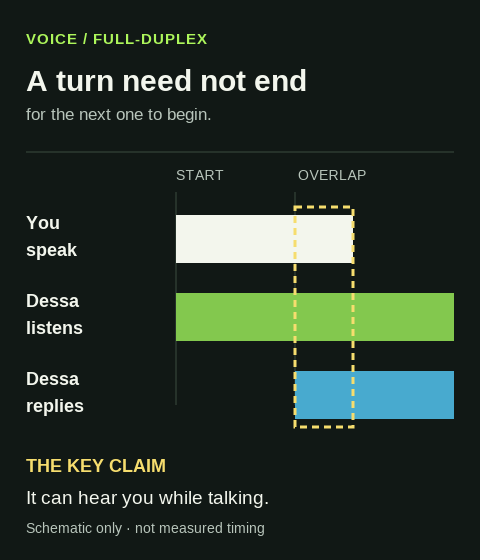
Block also says Dessa runs faster than real time on a MacBook Pro M4 Max or better. That is an inference claim, not a published distribution of response delays. Its separate statement that training used one NVIDIA GB200 NVL72 system does not mean one GPU, nor does it describe the machine needed for inference.
An expressive voice is not a safety result
Speech-only training is the distinctive bet here, not expressive voice itself. The Decoder’s October 24 report points to earlier conversational systems, including Hume’s EVI, Kyutai’s Moshi, and ChatGPT’s voice mode. Without a public architecture description, training-data detail, or comparable evaluation on Block’s announcement page, we cannot tell whether Dessa’s approach is more reliable than those alternatives.
Block argues that vocal cues matter when a person sounds distressed. They may—but noticing a cue, interpreting it correctly, and responding safely are different tests. Warmth in a recording proves none of them. The page invites a small safety-research cohort to request early access; its Download control says launch links are coming soon. We could not run the model or independently assess its responses.
The test that would change the story
For now, the strongest claim is narrow: Block has shown examples of speech that overlaps and reacts in ways a rigid turn-taking interface would not. A useful next test would let independent researchers interrupt Dessa repeatedly across different speakers, noise levels, long exchanges, factual corrections, and consented sensitive scenarios. Report both response timing and whether the answer was appropriate. Until those results and access details are public, this is an interesting direction for voice AI—not a demonstrated breakthrough in reasoning or safety.