What happened
Z.ai released GLM-5.3-Flash on August 26, 2026, and describes it as the GLM-5 family’s first natively multimodal model. It accepts text, images, and video and produces text, while targeting coding, tool use, and visual workflows. The model is available through Z.ai’s API and Coding Plan, and its weights are published on Hugging Face under the MIT license.
The surprising part is its scale: “Flash” does not mean small. GLM-5.3-Flash contains 320 billion parameters but activates 18 billion per token. The public FP8 checkpoint spans 62 weight shards, so open weights do not automatically imply laptop-class deployment.
Why it matters
A useful way to read this release is as an inference-economics experiment. Mixture-of-experts routing lowers per-token compute by activating only part of the network, while the attention design targets the memory and compute costs that grow with long contexts. If that combination holds up in production, “Flash” becomes an architectural property rather than merely a smaller model tier.
There is some independent context. Artificial Analysis reports an Intelligence Index score of 57, matching Z.ai’s headline, at standard API prices of $0.15 per million input tokens and $0.50 per million output tokens. Its page also measured about 50 output tokens per second—slower than its current comparison median—showing that low price, intelligence, and interactive speed are separate axes.
Technical context
Sparse compute, mixed attention
The public configuration describes 45 transformer layers: 34 use linear attention and 11 use sparse attention. Z.ai says linear attention models local dependencies through a recurrent state, while sparse layers retrieve global context through an indexer. Its IndexPool mechanism compresses four index-key vectors into one, and the model configuration advertises a one-million-token context window. Manifold-Constrained Hyper-Connections are also enabled, although the launch material does not isolate their contribution.
This design attacks two different costs. Expert routing limits active feed-forward computation; mixed attention and index compression target attention work and KV-cache growth. Z.ai claims reductions of roughly 3× in attention compute and 4.4× in KV-cache size versus GLM-5.3 under its analytical comparison—not end-to-end latency measurements.
Native vision changes the workload
The model includes a vision encoder rather than delegating images to a separate product. Z.ai frames this around visual coding loops: render an interface, inspect it, act, and refine. The released model card lists SGLang, vLLM, TokenSpeed, Transformers, KTransformers, and Unsloth deployment paths. Support exists, but the 320B total footprint still makes memory capacity, quantization, interconnect, and runtime maturity decisive.
What remains uncertain
Most coding, agentic, vision, and base-model comparisons in the launch post are Z.ai-run. Their footnotes disclose different harnesses, judges, context limits, timeouts, and sampling settings, so the table is not one uniform evaluation. Artificial Analysis independently supports its own index result, not the complete vendor benchmark suite.
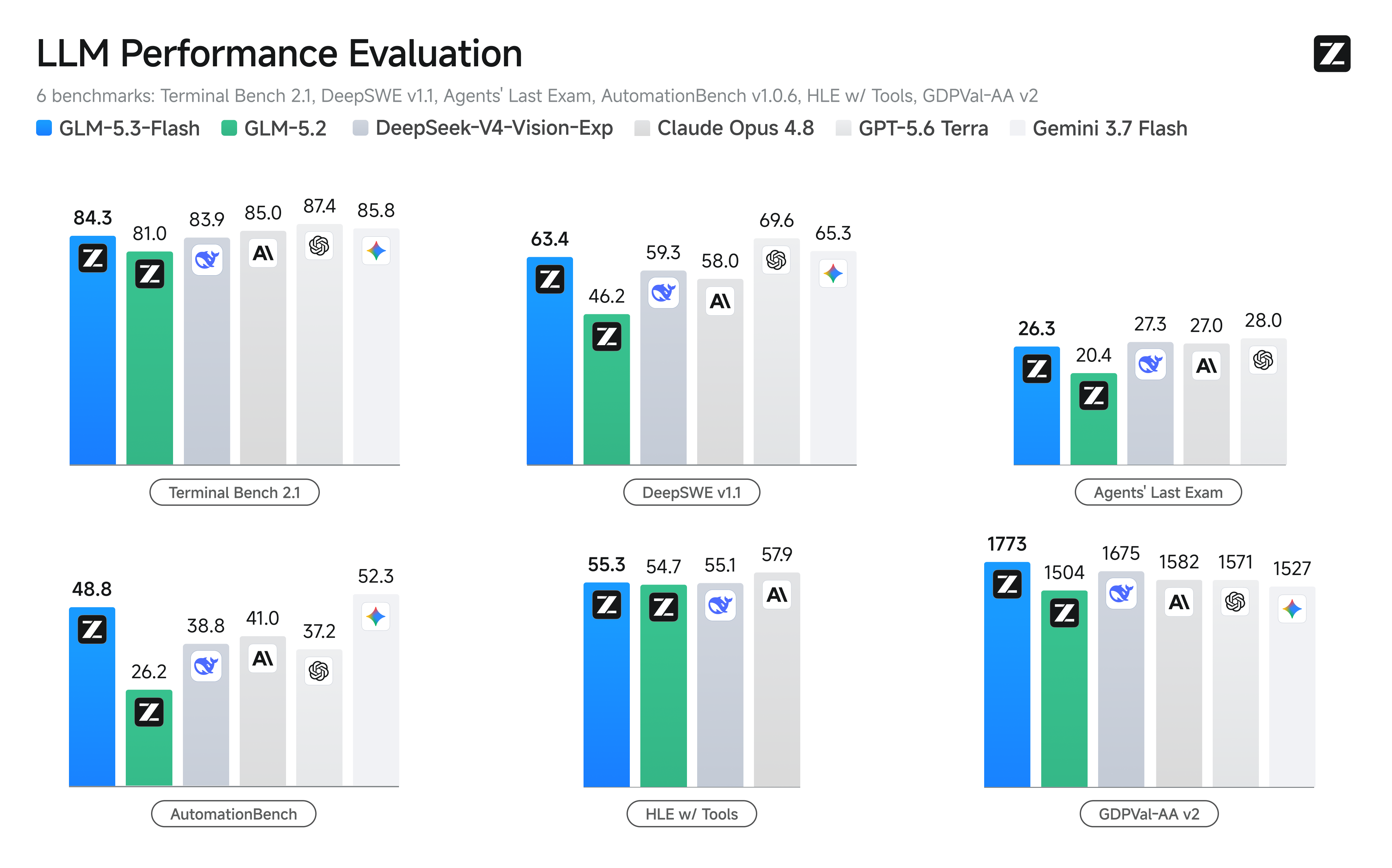
The linked February 2026 GLM-5 technical report predates GLM-5.3-Flash and does not document this release-specific hybrid architecture or claimed 30-trillion-token multimodal corpus. Z.ai also reports serving the model on a large cluster of Chinese AI chips with a 3× improvement over its initial baseline, but does not name the accelerators or publish telemetry sufficient to compare that system independently with NVIDIA deployments. API price therefore should not be treated as proof of self-hosted cost or reliability.
Practical takeaways
- Compare models at the same reasoning effort, context budget, harness, and timeout.
- Benchmark prefill latency, decode speed, KV-cache use, and vision encoding separately on the intended runtime.
- Size deployment memory from the full checkpoint and cache—not the 18B active count alone.
- Distinguish standard token prices from temporary promotions and total agent-task cost.
- Treat visual self-verification as a workflow hypothesis until artifact quality is tested end to end.