The October 26 launch of GPT-6.1 Terra creates an awkward question for OpenAI’s model menu: if Terra costs less than Sol, how much harder a job should you give it before reaching for Sol or Astra? OpenAI pitches it for image-heavy work, computer use, and writing. That is a useful position in the lineup, not a demonstrated rule for picking the best model.
A price gap, not an intelligence ladder
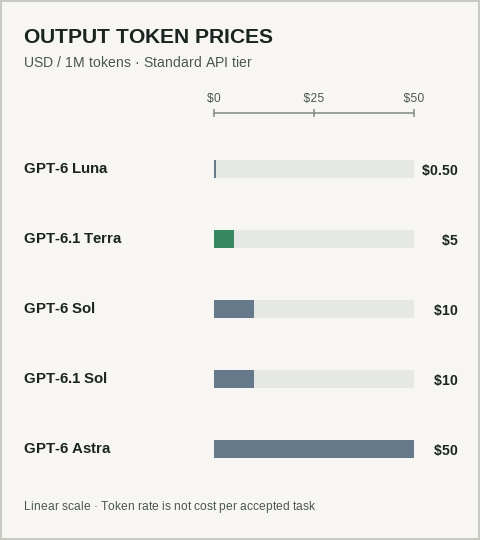
The API model pages put Terra at $1 input / $5 output per million tokens under Standard processing. Here is a source-grounded snapshot of the GPT-6 family; Sol appears twice because GPT-6 Sol and GPT-6.1 Sol are different model IDs, not interchangeable nicknames.
| Model | Documented role | Input | Output |
|---|---|---|---|
| GPT-6.1 Terra | Visual and professional work | $1 | $5 |
| GPT-6 Luna | Focused, high-volume tasks | $0.10 | $0.50 |
| GPT-6 Sol | Complex coding and agents | $2 | $10 |
| GPT-6.1 Sol | Coding and professional work | $2 | $10 |
| GPT-6 Astra | Most demanding tasks | $10 | $50 |
Role descriptions summarize OpenAI's positioning, not measured task boundaries. Swipe or scroll to see every column on narrow screens. Sources: Terra, Luna, Sol, 6.1 Sol, Astra.
All five model pages list a 1,050,000-token context window. That is a capacity specification, not proof of equal quality across long documents. Above 272,000 input tokens, OpenAI applies higher input, cache, and output rates to the whole request. Retries, tools, and reasoning tokens can further change the bill for an accepted answer.
Three evidence lanes that should not be merged
OpenAI reports 50.3% on Terminal-Bench 4.0 at maximum reasoning effort for Terra, versus 21.5% published for GPT-5.6 Terra. That is a predecessor contrast, not a five-model, same-run leaderboard. Its computer-use comparison uses OSWorld 2.1, while earlier GPT-6 coverage used OSWorld 2.0; joining those scores into one ranking would change the test beneath the reader’s feet.
There is independent but different evidence. Artificial Analysis reports its Intelligence Index v4.3.2 for maximum-effort variants: Terra 48, GPT-6.1 Sol 52, Luna 38, and Astra 53, as checked October 28. It is a composite of that evaluator’s tests, not an independent reproduction of Terra’s Terminal-Bench or computer-use launch results. Terra was not listed in the Terminal-Bench organizer’s leaderboard at review time; that absence does not disprove OpenAI’s result.
What the system card changes about the choice
The Terra system-card addendum classifies the model’s cybersecurity capability as Critical and biological/chemical capability as High under OpenAI’s framework. It describes deployment safeguards, but also records statistically significant regressions versus GPT-5.6 Terra in hate and extremism image-input safety tests. A capability gain is not a blanket safety gain. The card cautions that research/API evaluations can differ from production ChatGPT through prompts, tools, and effort settings.
OpenAI says Terra launched in ChatGPT Work and Codex for Plus, Pro, Enterprise, and Edu users, as well as the API as gpt-6.1-terra; that does not promise identical tools or behavior on every surface. For a real choice, give Terra and the plausible alternative the same visual or computer-use tasks at matched effort and permissions. Track accepted results, retries, elapsed time, safety interventions, and total spend. Start with Terra if its quality passes that test; keep a stronger model as an escalation path, not as a permanent winner declared by a mixed-protocol chart.
Sources
- OpenAI — Introducing GPT-6.1 Terra
- OpenAI Developers — model documentation: GPT-6.1 Terra, GPT-6 Luna, GPT-6 Sol, GPT-6.1 Sol, and GPT-6 Astra
- OpenAI — GPT-6.1 Terra system-card addendum
- Artificial Analysis — GPT-6.1 Terra, GPT-6.1 Sol, GPT-6 Luna, and GPT-6 Astra release pages
- Artificial Analysis — evaluation methodology
- Terminal-Bench — organizer leaderboard