The model does not answer the user
Jev is being discussed because it reverses the usual AI-model pitch. It is not trying to write a better paragraph, complete a longer chain of thought, or replace a general-purpose chat model. TypeSafe describes it as a “System One” model: give it a state and typed questions, then receive structured decisions, probabilities, and confidence values.
That makes Jev classification-like, but “just a classifier” is too narrow. A question can ask for a choice, a score, or a yes/no-style probability called a Noul. One request can ask all three about the same state. The state can be a string, a JSON object, or an array of text values; the questions define the judgments the software needs.
For example, a support system could pass a ticket and ask which team should handle it, how frustrated the customer sounds, and whether the request is urgent. The result is not a generated reply. It is typed data that ordinary code can route, score, or use in a guardrail.
The inference contract is the real difference
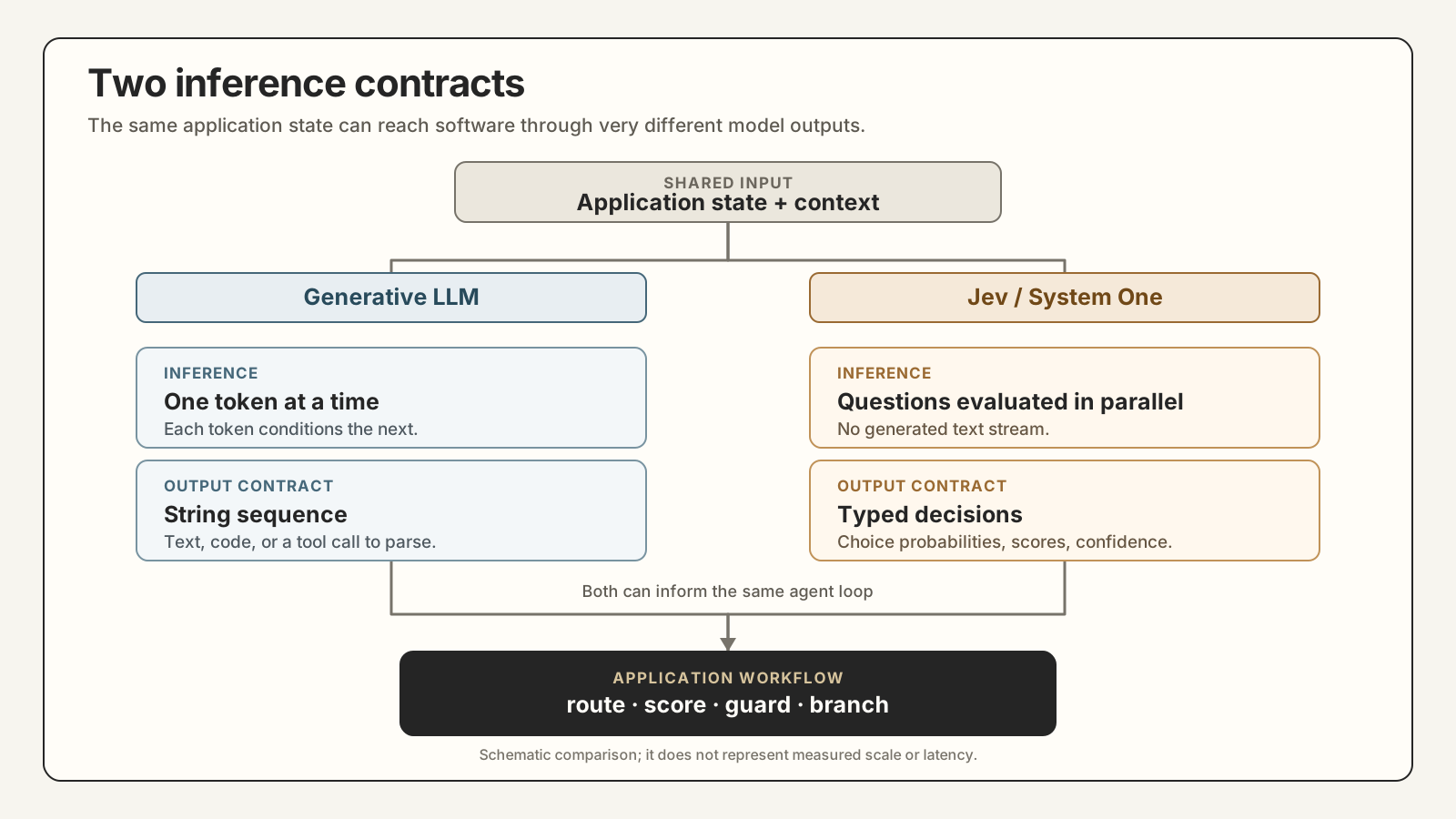
A conventional generative LLM usually produces a string autoregressively: it generates one token, conditions on that token, and continues. Software then has to parse and validate the result, while the model may still produce malformed data or an answer that wanders outside the intended action space.
TypeSafe’s key claim is that Jev generates the requested outputs in parallel and returns values whose possible structure is defined before inference. Its official documentation shows Choice, Score, and Noul responses with probabilities and confidence. That is not merely a shorter chat response. It is a different interface between inference and software.
The trade is equally important: Jev gives up free-form string generation. It cannot replace the model that writes the explanation, designs the feature, or handles an unfamiliar conversation. Its advantage appears when the application already knows which decisions it needs and can describe them as typed questions.
Why the numbers travel so well
TypeSafe reports 70–500 millisecond end-to-end responses, $0.042 per million input tokens, and workflow comparisons claiming up to 193.6× faster and 444.6× cheaper results. Those are attention-grabbing numbers because they target the part of agent systems that repeats constantly: routing, triage, scoring, risk checks, and branching.
The company also supplies important limits. The workflow evaluations were created by its capabilities team, and the reference probabilities come from larger models—including Astra and Fable. TypeSafe says the workflows may contain bias, that the comparison is not a universal benchmark, and that the LLM baselines use a wrapper to produce structured decisions. Jev’s guaranteed type safety is not the same as guaranteed correctness: a typed answer can still be the wrong judgment.
LangChain’s Jev integration makes the idea easier to try. Its examples place Jev in model-routing middleware and tool-risk gating, alongside a larger generative model. That is the hot topic behind the social attention: Jev suggests that agent quality and cost may improve by splitting “decide” from “explain.”
The useful question is where it fits
Jev is promising when a workflow needs many fast, bounded judgments with uncertainty exposed. It is less appropriate when the output itself is the product: prose, code, open-ended research, or a conversation.
Before treating the headlines as a general LLM breakthrough, test five things: whether your decisions can be expressed as typed questions, whether its probabilities are calibrated on your data, whether false positives and missed risks are acceptable, whether the latency and cost claims hold in your region and workload, and where a larger model still needs to take over. The interesting shift is not that Jev replaces generative AI. It is that an agent may not need a generative model for every decision it makes.
The official TypeSafe announcement is dated September 15, 2026. The JevAI Community site and Jevable are unofficial community resources, so their playbooks, project descriptions, and claims should be treated as community material rather than TypeSafe product documentation.