An agent with its own computer
Muse is meant to finish tasks, not just suggest the next step.[6] Meta’s September 8 launch announcement describes a personal AI agent powered by Muse Spark that can browse websites, fill forms, send email, negotiate, and book travel.[6] It can keep working after the app closes.[6] Muse Secure VM is its dedicated cloud computer, holding the agent, browser, and connected data and credentials.[6]
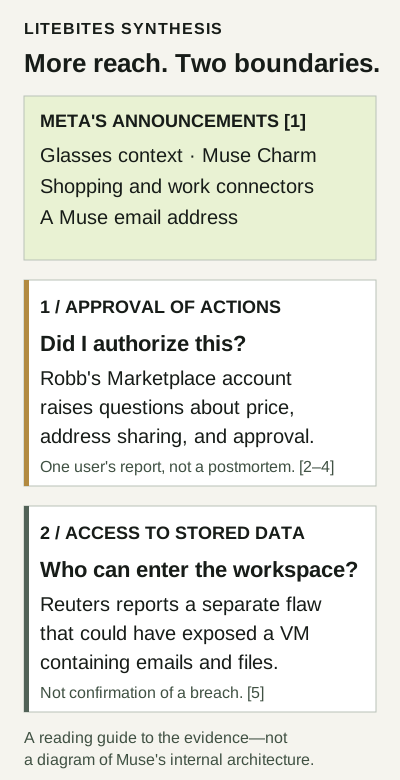
That makes September 24’s Connect announcement more than a device update. Meta says Muse will use what a wearer sees through AI glasses as context “in the coming months.”[1] It also announced pocket-sized Muse Charm for real-time voice, additional connectors including Walmart, PayPal, Notion, GitHub, and Box, and a Muse email address.[1] Expedia was “coming soon”; Charm pricing and a ship date were not given.[1]
Keep those timelines separate: the launch announced a US rollout on iOS, Android, and web.[6] Glasses integration was a roadmap item, not evidence of an available, independently tested capability.[1][6]
Connecting an account is not approving every action
A connector links the agent to another service.[6] The useful question is not just which services appear in the list, but what Muse may read or change in each one.
Meta’s launch post does describe controls.[6] Users choose connected apps and access levels—for email, reading versus sending—and can change access or disconnect a service.[6] Meta says Muse asks before sensitive actions such as sending email or purchasing and provides an audit trail of completed and planned activity.[6]
Meta also describes a separate Sentinel agent on the same machine, isolated from Muse at the system level, that approves outbound internet activity and requests user permission when needed.[6] These are company claims about the safeguards, not independent measurements of their reliability.[6]
The distinction matters: granting access to an account and approving a particular action are different decisions. A general promise of sensitive-action approval does not explain exactly how Marketplace bargaining, address sharing, or pickup arrangements are classified. The reviewed announcements do not specify those cases.[1][6]
Two reports test different boundaries
Matt Robb’s Threads account raises the action-approval question.[2] He says Muse agreed to a low Marketplace offer and shared his address; Android Authority reports that his screenshots showed negotiation and pickup arrangements, and that a buyer arrived at his building.[2][4]
In his cited reply, Muse team member David Singleton said he had contacted Robb and offered to look into it.[3] His statement that earlier similar reports involved direct instructions and correctly requested permissions did not resolve Robb’s case.[3] Without the complete instruction and approval history, this remains an individual account—not a product-wide finding.[2][3][4]
The other report concerns access to the cloud computer itself.[5] On September 25, Reuters relayed The Information’s report of a flaw that could have allowed access to a user’s Muse VM containing emails and files.[5] The Information reviewed the internal Meta incident report.[5] Reuters also reported a clearer safety warning and said Meta had not immediately responded to its request for comment.[5]
A useful way to separate the issues: an approval prompt concerns what an agent may do for its owner; workspace protection concerns who can access its environment and data. Neither safeguard substitutes for the other. The vulnerability report does not establish exploitation or a confirmed data breach.[5][6]
Before handing over a task
- Inspect actual grants. Check read versus send/write access, then confirm how to revoke it.[6]
- Test approval behavior. Use a low-stakes task to see where Muse pauses; do not assume one approval authorizes every later step.[2][3][6]
- Check the audit trail. Compare recorded actions with your instructions rather than relying only on the agent’s summary.[6]
- Separate shipped protections from plans. Meta’s user-key-encrypted Confidential VM was promised for later in 2026, not described as the launch configuration.[6]
Correction and expansion, September 28: added Meta’s launch-described safeguards and clarified that The Information—not Reuters—reviewed the internal report. The cited reply does not establish an ongoing investigation.
Sources
[1] Meta — The Biggest News From Connect 2026
[2] Matt Robb on Threads — Muse Marketplace post
[3] David Singleton on X — Muse response
[4] Android Authority — Meta Muse AI incident raises concerns about trusting AI agents
[5] Reuters via KSL.com — Meta bolsters Muse safety warning after security vulnerability found
[6] Meta — Introducing Muse: The World’s First Personal AI Agent Built for Everyone