A support ticket arrives. Before anyone writes a reply, the system needs three smaller judgments: Does it need a human? Which team should see it? How serious is it? Perplexity’s Decisions API answers those questions as probabilities instead of paragraphs. If that sounds like TypeSafe’s Jev, introduced on September 15, it should. Perplexity’s guide does not disclose its original publication date; its October 1 metadata is a revision date, not a verified launch date. The interesting question is whether you can trust a replacement in the same workflow.
The shared shape: state, questions, numbers
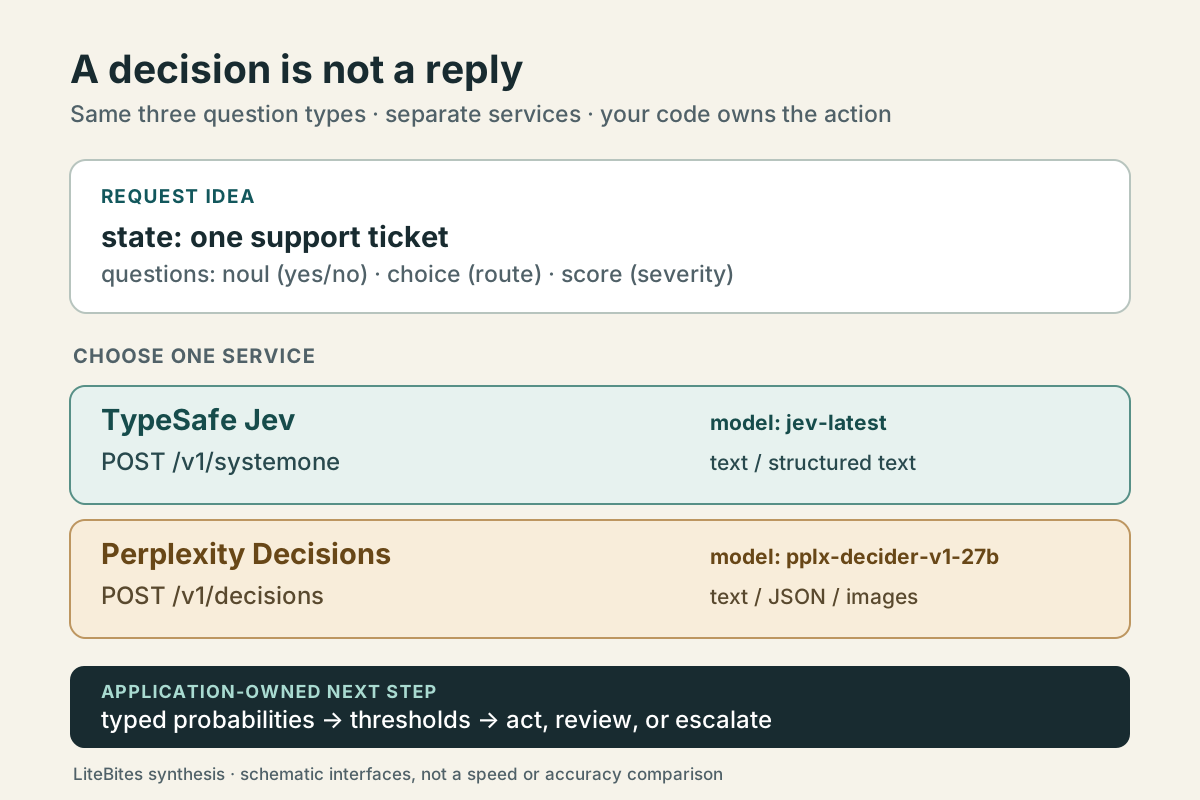
Both services take a state—say, a ticket with a subject and body—and named questions about it. A noul returns a yes/no probability; a choice distributes probability across options; a score rates an ordered rubric. You can ask all three in one request and let code apply thresholds or request human review. Neither API needs to generate a customer-facing explanation to make that preliminary decision. Perplexity’s schema and TypeSafe’s interface document that common pattern.
The model behind each endpoint is different: Perplexity specifies pplx-decider-v1-27b at POST /v1/decisions, while TypeSafe lists jev-latest at POST /v1/systemone. The similar vocabulary does not establish shared model weights, equal probability calibration, or compatible error handling. An application needs an adapter and tests, not just a changed base URL.
Where the two contracts diverge
Perplexity lists $0.04 per million input tokens, with free output tokens and no request fee. TypeSafe lists $0.042 per million input tokens for Jev, also with free output. That tiny published rate difference says little about total workflow cost: retries, reviews, and wrong automatic actions matter more. These are provider prices, not a measured head-to-head cost per correct decision.
The input envelopes differ more. Perplexity accepts text, JSON, and base64-encoded images, with an input limit below 262,144 tokens and up to 128 questions per call. Jev’s documented model takes text/structured text, not images, with a 64k-token total budget and an additional 32k limit for state plus the longest question. Perplexity documents 10 requests per second per organization; TypeSafe lists 80, while warning that its limits can change. Neither limit predicts latency or accuracy on your data.
A decision service is not a search agent
The Perplexity name can mislead here. Its Agent API does web-grounded, tool-using generation; the Decisions API returns bounded judgments about the state you supply. Perplexity’s ticket-triage example sends only escalated tickets to the Agent API for an investigation plan. That is a vendor example of a two-stage design, not independent evidence that its decision model outperforms Jev.
Likewise, TypeSafe’s API supplies typed decisions, not an agent’s full routing or screening policy. Perplexity also supplies a decision primitive, not a ready-made replacement for application policy. The application still owns the consequences of a false negative or a confident-looking wrong choice.
What to test before switching
- Replay labeled tickets or routing cases through both endpoints with identical question criteria. Compare the actions your code takes, not just the top label.
- Check calibration near your review threshold and route uncertain or high-stakes cases to a person or a stronger model.
- Test image inputs separately: they are a Perplexity feature, not evidence of better text-only decisions.
- Measure end-to-end latency, retries, rate limits, and cost on your workload. No public comparison cited here establishes a winner.
Sources
- TypeSafe AI — Introducing System One Models & Jev (September 15, 2026)
- Perplexity — Decisions API guide
- Perplexity — Decisions API request and response reference
- Perplexity — Ticket-triage example
- Perplexity — Agent API guide
- TypeSafe — Jev introduction
- TypeSafe — Jev model specifications and pricing
- TypeSafe — System One API reference