What if an AI could fix another model by changing a few numbers in its weights—not by running a training job? In a November 2 research post, Rikiya Takehi and colleagues at MIT CSAIL describe asking GPT-6 Astra to do exactly that to Qwen3.5-0.8B. The team’s headline math score jumped from 7.9% to 48.1%. The more interesting question is what the edit actually fixed.
The model was getting stuck
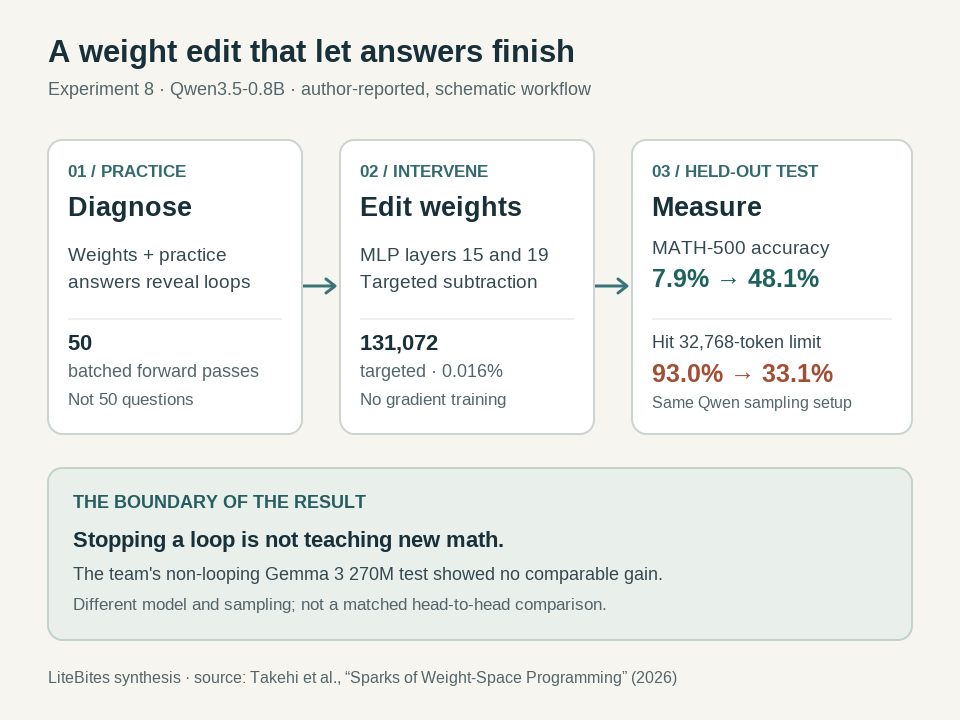
The authors ran Qwen in thinking mode with a 32,768-token answer limit. Under their specified sampling settings, it often repeated itself instead of finishing: 93.0% of its MATH-500 answers hit the limit. The Qwen model card also warns that this small model can enter thinking loops; that warning is context, not an independent replication of this benchmark.
Astra had a Python session with access to the weights and practice problems from the training sets of GSM8K and MATH. It could choose prompts and inspect the model’s responses through a budget of 10, 25 or 50 batched forward passes; it could not use gradients or see the held-out evaluations. In the 50-pass run, the authors say Astra traced the looping to a direction written by MLPs in layers 15 and 19, then subtracted it from selected output columns: 131,072 targeted weight positions, about 0.016% of the model. The released edit manifest counts 130,188 stored values that actually changed after bfloat16 rounding. This was direct weight editing, but emphatically not a feedback-free guess.
A score jump with a narrower explanation
With the 50-pass edit, the team reports 48.1% on MATH-500, 67.1% on GSM8K and 62.3% on IFEval, versus 7.9%, 13.8% and 21.0% for its unedited Qwen baseline under the same sampling setup. On MATH-500, token-limit hits fell to 33.1%. Earlier 10- and 25-pass edits barely reduced that limit-hit rate and delivered much smaller math gains. The correspondence makes the loop fix a compelling explanation, but the reported scores alone do not isolate every causal contribution.
Crucially, freeing a model to finish its reasoning is not the same as teaching it new reasoning. The authors also tried Gemma 3 270M, which rarely hit its own token limit. After up to 50 practice passes, their MATH-500 scores remained between 6.8% and 7.7% across the baseline and edited variants; the 50-pass result was 7.0%. That is a different model with different sampling settings, not a matched head-to-head benchmark. It is a useful failed extension of the weight-editing idea: no similarly obvious loop defect, no comparable improvement.
What would make this a method?
The team published experiment logs and an edited Qwen checkpoint, making the reported procedure more inspectable than a score-only claim. It is still an early research demonstration, not a reliable recipe for upgrading arbitrary models. A convincing next test would repeat the intervention across seeds, model families and sampling configurations, compare it with simpler loop mitigations, and check whether the changed weights help without harming other tasks.
For now, the result is best read as targeted repair of a conspicuous failure mode, with a large benchmark consequence—not evidence that a tiny hand-written edit generally manufactures math ability. If you evaluate the checkpoint yourself, inspect both answer accuracy and the rate of responses that exhaust the token budget.