Paper brief
Chain-of-Zoom: Extreme Super-Resolution via Scale Autoregression and Preference Alignment
Chain-of-Zoom treats extreme super-resolution as a sequence of zoom steps, using multi-scale prompts and preference alignment to guide details beyond a model's usual scale range.
Why this paper matters
Single-image super-resolution is an ill-posed problem: one low-resolution image can correspond to many plausible high-resolution images. The problem becomes harder when the target scale moves beyond the regime that a model saw during training.
Chain-of-Zoom asks how to push super-resolution further than a fixed one-step upscaling model. Instead of trying to jump directly from a very small image to an extreme high-resolution image, it models the process as a chain of intermediate zoom states.
The bite
The key idea is scale autoregression. Chain-of-Zoom repeatedly applies a super-resolution process across multiple scale states, where each step predicts the next zoomed image from previous states.
The method also uses vision-language guidance. As details become uncertain during repeated magnification, a vision-language model extracts text prompts from multi-scale image context. These prompts help the super-resolution model preserve semantic detail rather than relying only on sparse pixels.
How it works
Chain-of-Zoom represents generation as a sequence from a low-resolution input to progressively higher-resolution states. Each step depends on recent image states instead of treating super-resolution as a single isolated transformation. This makes the process closer to next-scale prediction than one-shot restoration.
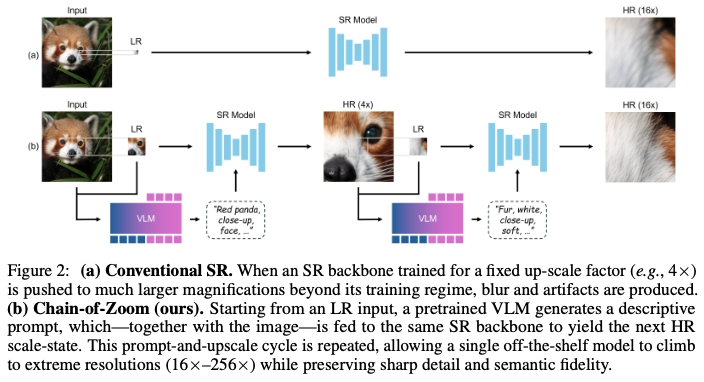
A central design choice is multi-scale-aware prompt extraction. The prompt generator looks at more than one resolution state, which helps it describe the content that should survive the next zoom step. This is meant to reduce hallucination compared with relying on a single sparse magnified patch.
The paper also uses preference alignment for the prompt generator. In the source note, the important pieces are critic preference reward, phrase-exclusion reward, and repetition penalty. Together, these rewards encourage prompts that are semantically helpful, avoid unhelpful template phrases, and reduce repetitive text.
What to look at in the results
The most relevant examples are extreme magnification cases where ordinary super-resolution models are likely to blur, invent, or collapse details. Look at whether Chain-of-Zoom maintains plausible structure across repeated zoom steps.
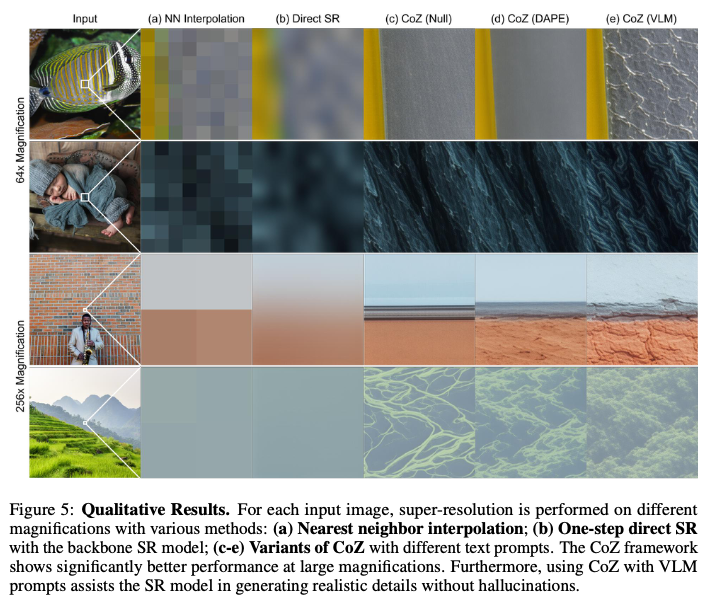
It is also worth checking the role of the text prompts. If the prompts are useful, the model should preserve semantic identity and local detail better than a scale-only pipeline. The caveat is that language guidance can also introduce hallucinated details, so alignment and prompt quality matter.
Practical takeaways
- Extreme super-resolution is better viewed as a multi-step problem than a single jump.
- Scale autoregression lets the model reuse intermediate zoom states.
- Vision-language prompts can supply semantic guidance when pixel evidence becomes sparse.
- Preference alignment is important because bad prompts can amplify hallucinations.
- When reading the paper, focus on how quality changes across repeated zoom steps, not only the final image.