Paper brief
DreamBooth: Fine Tuning Text-to-Image Diffusion Models for Subject-Driven Generation
DreamBooth turns subject-driven image generation into a lightweight personalization problem: bind a rare token to a specific subject, then regularize fine-tuning so the model keeps both the subject identity and the broader class prior.
Why this paper matters
Text-to-image models became good at generating plausible dogs, bags, or clocks in general, but they were still bad at generating your dog, your bag, or that specific yellow clock from a few reference photos. A text prompt could describe a subject class, but not reliably lock onto a particular instance.
This paper matters because it reframes that gap as a personalization problem. Instead of asking a model to infer identity from an elaborate description every time, DreamBooth fine-tunes the model once on a tiny subject-specific set, then lets the user call that subject back with an ordinary prompt.
The bite
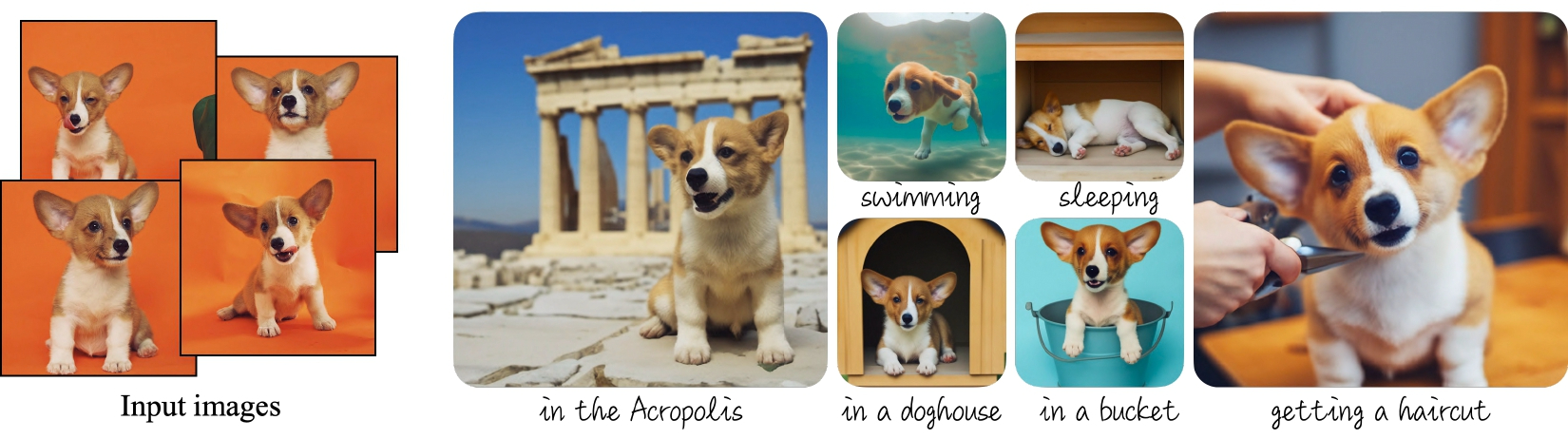
The key idea is to bind a rare text token to one specific subject and fine-tune a diffusion model so that the token behaves like a name for that subject. After that, prompts such as “a [V] dog on the beach” can generate the same dog in new scenes, poses, and lighting conditions.
What makes the method work is that the paper does not treat personalization as simple memorization. DreamBooth wants the model to remember the subject’s identity and preserve the class prior around it. That is why the model can generate a specific subject in novel contexts rather than only replaying the training images.
How it works
The training setup is intentionally simple. The authors start from a pretrained text-to-image diffusion model and fine-tune it on just 3–5 images of a subject. Each image is paired with a prompt that contains a rare identifier token and the class name, such as “a [V] dog.” The identifier is what becomes subject-specific, while the class noun keeps the model anchored to its broader semantic prior.
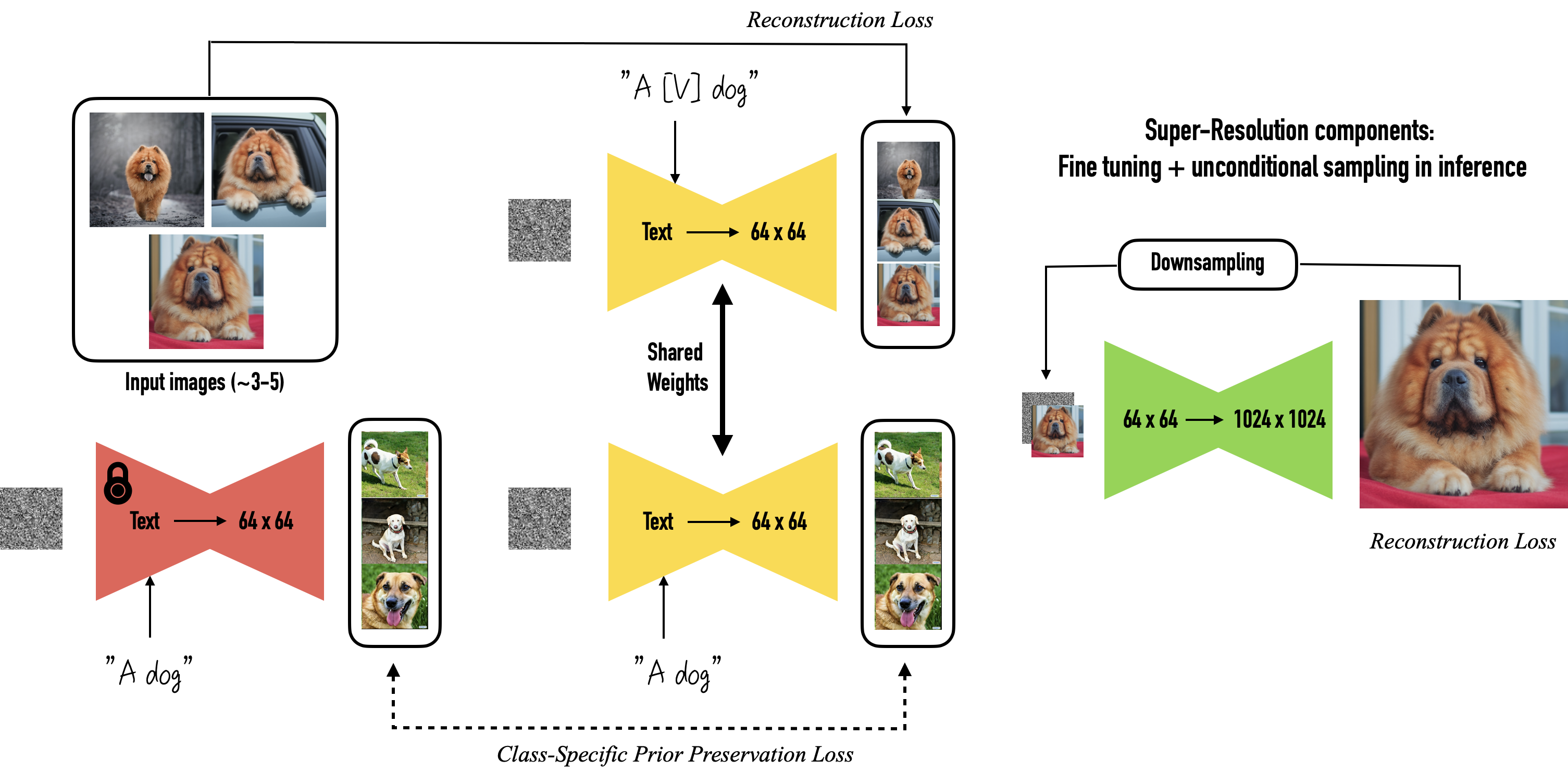
The most important technical piece is the class-specific prior preservation loss. Without it, the model can drift and start treating the whole class word, such as “dog,” as if it meant that one training instance. The extra loss tells the model to keep generating diverse examples of the class itself, which reduces language drift and helps preserve output diversity.
The paper also spends time on prompt design. Using the right class noun matters, and using a rare token matters, because the model has to learn a clean association rather than fight with an already overloaded word. A useful way to read the method is as a careful compromise between subject binding and class retention.
What to look at in the results
The paper’s core claim is not only that DreamBooth looks good visually. It is that it keeps subject identity while still following new prompts well. So when you read the results, focus on the tension between subject fidelity and prompt fidelity rather than just whether the generated images are attractive.
The comparison with Textual Inversion is especially worth watching. DreamBooth wins not because it produces wilder images, but because it better preserves the specific subject while still responding to the requested scene. The paper also shows that prior preservation improves diversity and reduces overfitting, which supports the claim that the method is doing more than storing a tiny image set inside the model.
One caveat is that the method is still a fine-tuning-based personalization recipe. That means it is practical and powerful, but it also raises the usual concerns around compute cost, misuse, and subject-specific overfitting when the prompts stay too close to the training set.
Practical takeaways
- Personalization works better when the model learns a new subject identifier without collapsing the surrounding class concept.
- The class noun is not a minor detail here; it is part of the mechanism that keeps generation flexible.
- A few-shot generative method should be judged on both identity preservation and prompt following, not just image quality.
- Regularization is doing real work: without prior preservation, subject binding can easily turn into language drift or low-diversity memorization.
- When reading the paper, treat DreamBooth as a personalization recipe, not just as another diffusion fine-tuning trick.