Paper brief
LoRA: Low-Rank Adaptation of Large Language Models
LoRA freezes a pretrained language model and learns small low-rank update matrices, making task adaptation much cheaper to train, store, and switch.
Why this paper matters
Full fine-tuning becomes increasingly awkward as language models grow. Updating every parameter requires large GPU memory, creates a separate full model checkpoint for each task, and makes deployment harder when many downstream tasks need to be supported.
LoRA focuses on a practical deployment problem: how can we adapt a large pretrained model while training and storing only a tiny number of additional parameters?
The bite
The key idea is to freeze the pretrained weights and represent the task-specific update as a low-rank decomposition. Instead of learning a full dense update matrix, LoRA learns two much smaller matrices whose product acts like the update.
This is useful because many downstream adaptations do not need to change the full parameter space directly. If the needed update can be approximated in a low-dimensional subspace, then the model can be adapted with far fewer trainable parameters.
How it works
In conventional fine-tuning, the model starts from pretrained weights and directly updates them for a downstream dataset. LoRA keeps the pretrained weight fixed. For selected layers, it adds a parallel low-rank branch that computes an update and adds it to the original layer output.
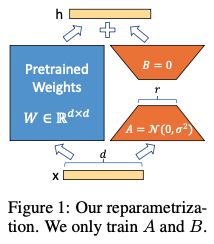
A useful way to picture this is a frozen main road with a small trainable side road. The main pretrained transformation remains available, while the LoRA branch learns the task-specific correction. Because the branch is small, training requires much less optimizer state and memory than full fine-tuning.
LoRA also avoids a common drawback of sequential adapters. Some adapter methods insert extra layers into the model path, which can add inference latency. LoRA’s update can be merged into the original weights for deployment, so it can adapt the model without keeping a separate slow path at inference time.
What to look at in the results
The important comparison is not only accuracy. Look at the trade-off between quality, trainable parameter count, memory usage, and deployment convenience. LoRA is compelling when it stays competitive with full fine-tuning or larger adapters while using far fewer trainable parameters.
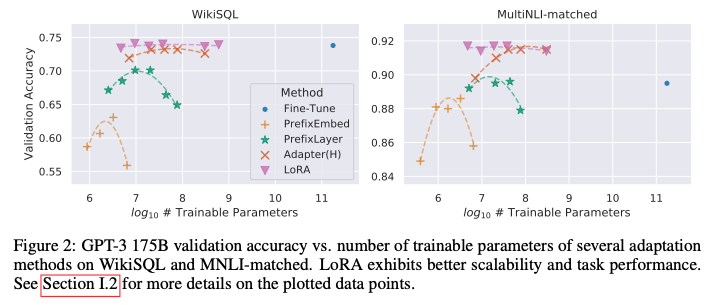
Also check how the method behaves across different parameter scales and tasks. A good parameter-efficient method should not work only at one carefully chosen size; it should remain reliable as the model and task setting change.
Practical takeaways
- Full fine-tuning large models is expensive to train, store, and deploy.
- LoRA adapts a frozen model by learning small low-rank update matrices.
- The method is parameter-efficient because the learned update is constrained to a low-rank form.
- LoRA can reduce deployment friction because task-specific updates are small and swappable.
- When reading the paper, focus on the accuracy-versus-trainable-parameters trade-off.