What happened
Apple announced two compact desktops on August 25, 2026: a Mac mini with M6 or M5 Pro, and a Mac Studio with M5 Max or M5 Ultra. U.S. starting prices are $899 and $1,699 for the two mini tiers, then $2,499 and $5,499 for Studio. Preorders are open, but the machines do not ship until September 22; the 512GB-memory Studio configuration follows in late October.
Apple emphasizes Neural Accelerators inside the GPU cores, faster storage, Wi-Fi 7, Bluetooth 6, and—on the higher tiers—Thunderbolt 5. Its marketing calls the mini an always-on agentic computer and the Studio a home for frontier-class models. The more useful distinction is not the branding, however. It is how much unified memory each machine can supply, how quickly it can move that memory, and which software can use the accelerators.
Why it matters
These Macs form a local-AI capacity ladder, not one interchangeable product family. Model weights, KV cache, runtime buffers, macOS, and other applications compete for the same memory pool. A faster accelerator cannot run a model that does not fit, and a model that fits may still decode slowly when context growth stresses bandwidth.
That makes Apple’s desktop lineup unusually legible for AI buyers: entry-level experimentation at one end, high-capacity workstation inference at the other. It also makes the configuration premium part of the compute decision. The $899 mini starts with only 16GB of memory, while the headline 512GB Studio is a later, substantially more expensive option.
Technical context
Four memory tiers
The M6 mini tops out at 32GB and 170GB/s; M5 Pro mini at 64GB and 307GB/s; M5 Max Studio at 128GB and 614GB/s; and M5 Ultra Studio at 512GB and 1.2TB/s. These are configuration ceilings, not base specifications or memory wholly available to a model.
The gap matters even for sparse models. GLM-5.3-Flash activates 18 billion of its 320 billion parameters per token, yet its public FP8 checkpoint still spans 62 weight shards. Sparse compute does not turn total stored weights into an 18B memory footprint. That example does not establish Mac compatibility—the model card currently lists no MLX deployment path—but it shows why active parameters alone are a poor sizing rule.
Acceleration still needs software
M6 combines GPU Neural Accelerators with a Dual 16-core Neural Engine; the M5 Pro, Max, and Ultra configurations also place Neural Accelerators in their GPU cores. Apple’s MLX framework provides a native Apple-silicon path for model work, while Metal underpins many optimized applications. CUDA-dependent runtimes, custom kernels, and many video-generation workflows still need ports or alternative implementations. PCWorld highlighted that ecosystem boundary while noting that the new machines had not yet been independently benchmarked.
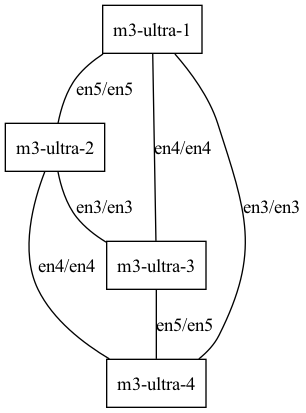
Apple also says built-in Thunderbolt 5 and RDMA support can cluster multiple Mac Studio systems, with a four-Studio cluster reaching up to 3× the AI-inference performance of one system. That is an Apple-tested result, not transparent scaling guaranteed for every runtime.
What remains uncertain
Apple says its cited launch-performance results come from July 2026 tests using selected systems, applications, model settings, and baselines. Independent reviewers cannot test shipping hardware yet, so claims such as 4× faster local AI or 4.3× peak AI compute should not be treated as general workload speedups.
Model fit also depends on quantization, architecture, context length, runtime overhead, and kernel support—not memory capacity alone. Local execution can reduce cloud exposure, but it does not guarantee privacy if an application uses remote fallbacks, telemetry, connected tools, or external model services. Multi-Mac inference likewise needs software that can partition work and tolerate communication costs.
Practical takeaways
- Choose memory capacity before comparing accelerator headlines.
- Estimate weights, KV cache, runtime buffers, and OS headroom at the intended context length.
- Confirm that the exact model and quantization work through MLX, Metal, or another supported runtime, then benchmark prompt processing, token generation, energy use, and sustained thermals separately.
- Treat clustered Macs as a systems project requiring a proof of concept, not automatic pooled compute.
- Compare the configured purchase price—not the base price—with cloud and CUDA-based alternatives.
Sources
- Apple Newsroom — Apple introduces M6 and M5 Ultra
- Apple Newsroom — New Mac mini with M6 and M5 Pro
- Apple Newsroom — New Mac Studio with M5 Max and M5 Ultra
- Apple — Mac mini Technical Specifications
- Apple — Mac Studio Technical Specifications
- The Verge — Apple’s new Mac Mini has fresh M6 and M5 Pro chip offerings
- PCWorld — Apple’s new Mac minis are primed for local AI
- GitHub — MLX
- MLX — Distributed communication
- MLX — MIT License
- Hugging Face — GLM-5.3-Flash