A 105-billion-parameter model running on one workstation GPU is the hook in Sarvam’s November 22 announcement. The interesting part is which model and which GPU. Sarvam-105B-1711 is a new post-trained checkpoint of its existing mixture-of-experts (MoE) base, not a new 105B architecture trained from scratch. Sarvam has released both unquantized BF16 and compact NVFP4 weights; the latter is the version behind its single-card demonstration and headline price–quality chart.
The checkpoint changed; the base did not
The model card describes 105B total parameters but about 10.3B active for each token: a MoE routes work to a subset of its experts. The 1711 release adds post-training aimed at instruction following, tool use, Indian languages and agentic conversations. Its public BF16 and NVFP4 repositories both declare Apache-2.0. Public weights and a license make the model inspectable and hostable; they do not independently verify the advertised quality or a product’s privacy controls.
Sarvam says it continued long-context training to 160K tokens. That is distinct from the 128K serving and evaluation setting in its published model card and benchmark configuration. Training context is not a promise that every hosted deployment offers the same limit.
What fits on a workstation
The NVFP4 repository contains roughly 65 GB of main model weights, with a separate draft model for speculative decoding. Sarvam stores most routed-expert weights at four-bit precision while other layers retain higher precision. This is not a uniformly four-bit model. The company reports serving it on one 96 GB RTX PRO 6000 Blackwell with vLLM, an FP8 key–value cache and its DSpark drafter. The larger BF16 checkpoint does not fit that one-card setup. Released weight files establish their availability and size; we did not run either checkpoint on a GPU.
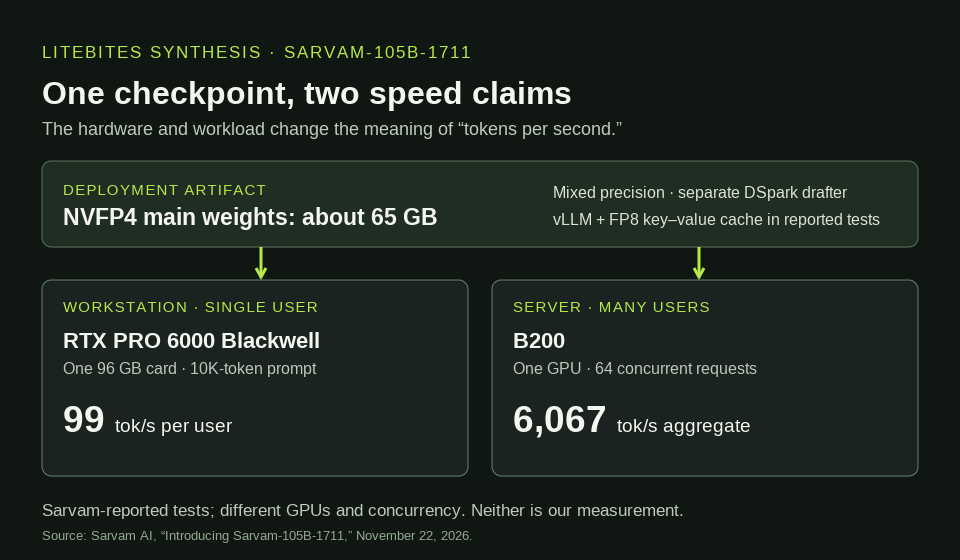
Those hardware numbers are easy to misread. In Sarvam’s workstation test, one request with a 10K-token prompt yielded 99 decode tokens per second for that user; at 50K, it reported 62. Its much larger 6,067 decode tokens per second figure is aggregate throughput on a B200, with 64 concurrent requests, NVFP4 and DSpark. It is not the speed of one user on the workstation. Both are company measurements under specified serving conditions, not our hardware tests.
The benchmark chart needs its footnotes
Sarvam plots an eight-benchmark conversational-agent average of 73.9 at $0.15 per million tokens. Recalculating the eight entries from its BF16-versus-NVFP4 table gives 73.9125 for NVFP4; the BF16 entries average 74.4625. The post also highlights stronger individual BF16 scores, including 82.5 on IFBench and 85.5 on Tau2. Those are not the individual scores underlying the NVFP4 headline. One eighth of the composite comes from Sarvam’s internal Indic-language suite, which is not a released evaluation set.
The evaluation YAML discloses model settings, graders and failure handling, but not the outputs or complete harness needed to independently reproduce the chart. Its GDPval-S is a Sarvam-run, 209-task cowork variant scored by a model against rubrics—not OpenAI’s official expert win rate. The YAML changed after the blog was published; its current revision omits a dedicated Advanced-IF entry even though that metric contributes to the headline average. Treat the chart as a vendor comparison, not an independent leaderboard.
The price needs a footnote too: Sarvam’s API page marks its Sarvam 105B API service rates of ₹10 input/₹25 output per million tokens as introductory. The blog’s $0.15 blend assumes three input tokens per output token and a specified rupee-to-dollar conversion. It is neither a universal API rate nor the cost of self-hosting the 96 GB card.
A useful first test
If the deployment story matters to you, start with the actual NVFP4 files and serving recipe, then test your own prompt lengths, concurrency, Indian-language conversations and tool calls on the hardware you would use. Compare the BF16 checkpoint separately. The open weights make that possible; the publisher’s selected demos, internal tasks and quoted speeds cannot substitute for a workload-specific run.