Paper brief
MoECLIP: Patch-Specialized Experts for Zero-shot Anomaly Detection
MoECLIP adapts CLIP to zero-shot anomaly detection by routing each patch through specialized LoRA experts, then explicitly separating those experts so patch-level specialization improves without giving up CLIP's transfer ability.
Why this paper matters
Zero-shot anomaly detection is appealing because real anomaly datasets are usually sparse, messy, and domain-specific. CLIP helps because it transfers across categories, but vanilla CLIP is not naturally built for small, localized defects or lesions that only occupy a few patches.
This paper matters because it targets a concrete weakness in recent CLIP-based anomaly methods: they usually adapt every patch with the same mechanism. MoECLIP argues that this is too blunt. Background patches, object-body patches, and anomaly patches should not all be processed the same way if the goal is fine-grained localization across unseen categories.
The bite
The key idea is to replace uniform patch adaptation with patch-specialized adaptation. MoECLIP inserts mixture-of-experts modules into the frozen CLIP vision encoder and lets each patch route to a small set of LoRA experts based on its own features.
That alone is not the full contribution, though. The paper’s stronger claim is that a naive expert ensemble is not enough, because the experts can collapse into doing similar things. So MoECLIP adds two explicit anti-redundancy mechanisms: Frozen Orthogonal Feature Separation, or FOFS, to keep each expert constrained to a different frozen subspace of the input features, and an ETF loss to push expert outputs into distinct directions.
How it works
MoECLIP keeps the pretrained CLIP backbone frozen and adds MoE-style LoRA adapters at several vision layers. For each patch, a router selects the most relevant experts, and their outputs are combined as a residual feature update. The design stays parameter-efficient because the adaptation happens through lightweight LoRA modules rather than full fine-tuning.
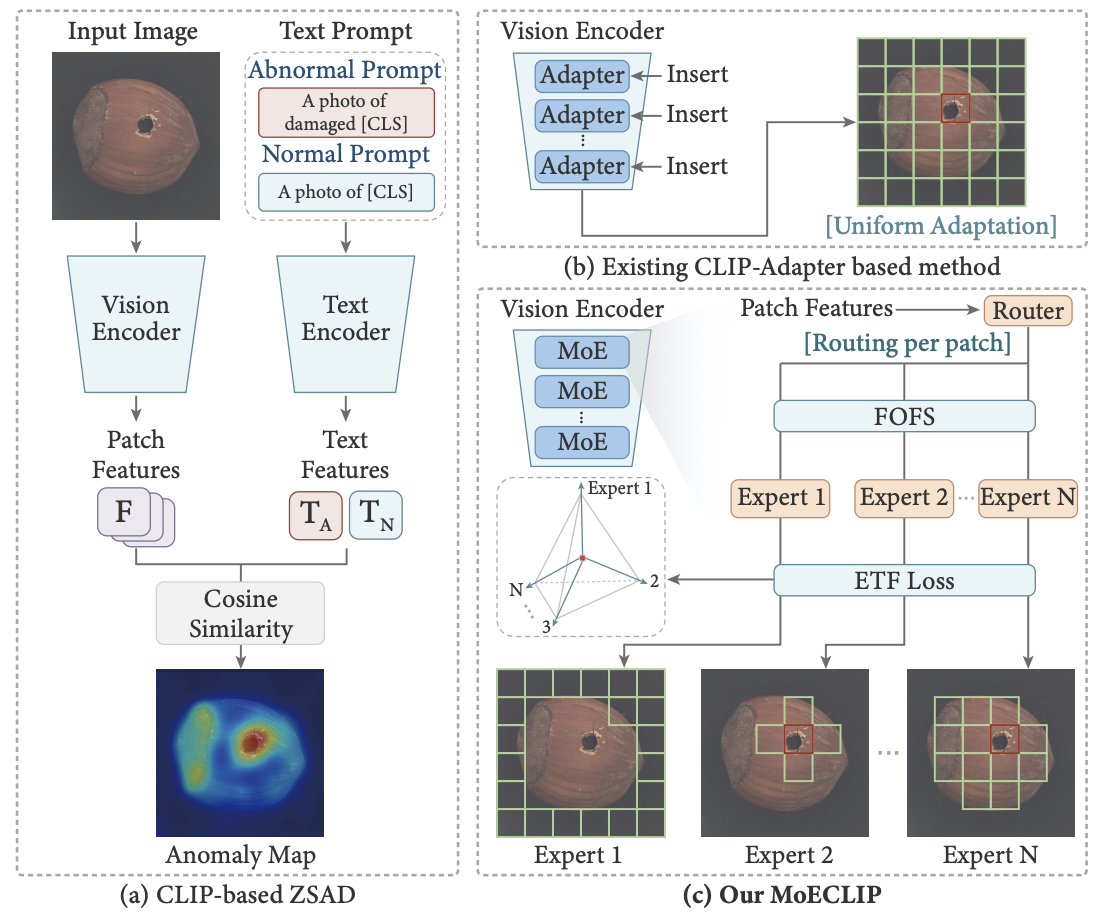
The method has three parts worth tracking. First, the router performs patch-level expert selection instead of applying one shared adapter to every region. Second, FOFS freezes the LoRA input projection so each expert stays confined to a different orthogonal slice of the feature space. Third, the ETF loss regularizes expert outputs so they remain well separated instead of drifting back into redundant behavior. The paper also uses a balance loss to avoid expert collapse during routing.
The rest of the pipeline is there to make those expert features useful for detection. Patch Average Aggregation adds multi-scale local context, projection layers align patch features to the text space, and the final anomaly map and image-level score come from similarity to normal and abnormal text prompts. A useful way to read the architecture is as a CLIP-preserving patch adapter: specialize locally, but do not destroy the backbone’s broad transfer prior.
What to look at in the results
The most important evidence is not any single dataset win. It is the average improvement across both industrial and medical benchmarks. Under the paper’s evaluation protocol, the model is trained on VisA for most cross-dataset evaluations, while VisA itself is evaluated using a model trained on MVTec-AD for fairness. Within that setup, MoECLIP improves the average image-level and pixel-level results over strong recent CLIP-based baselines, which supports the paper’s broader case for better cross-category transfer.
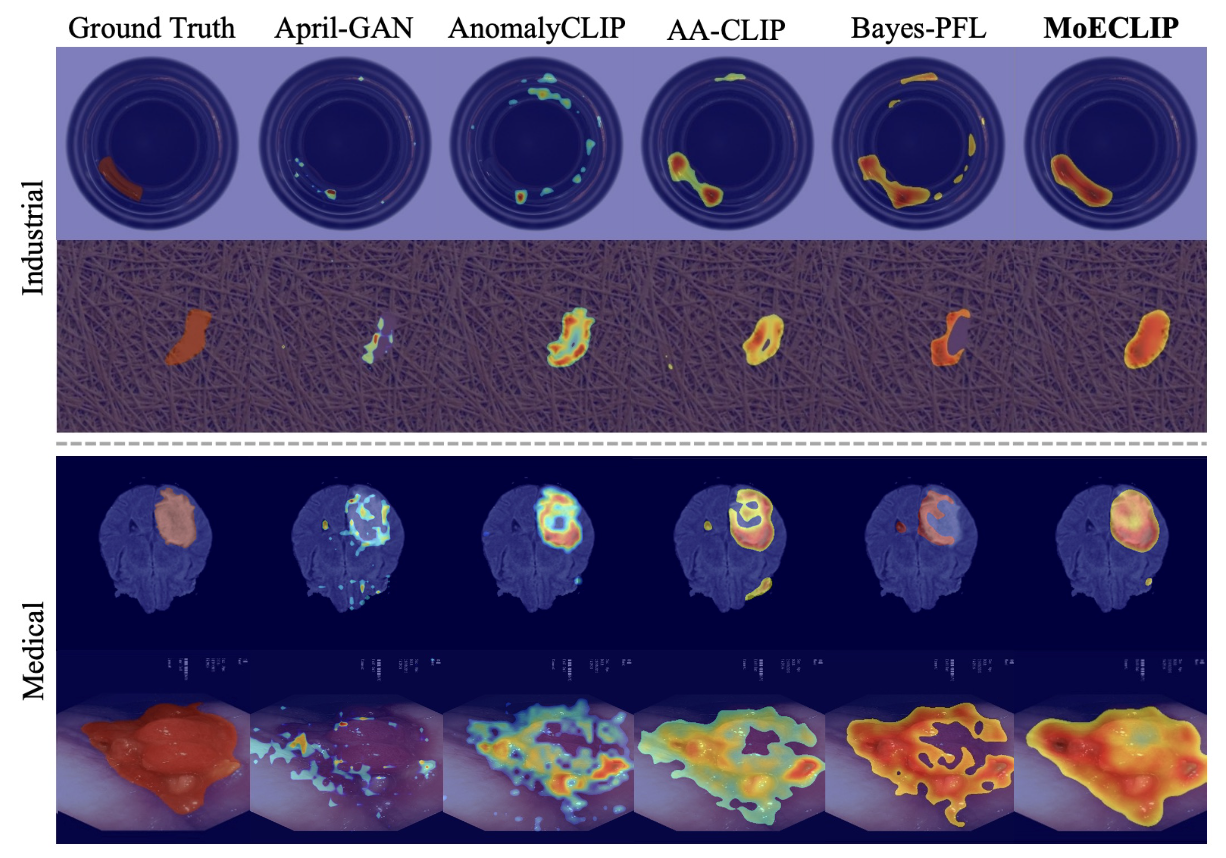
The qualitative comparison below is not a substitute for the benchmark table, but it is a faster way to see what the paper is claiming in practice: sharper localization and fewer diffuse false regions across both industrial and medical examples.
The ablation is also important here. The paper shows that adding experts alone already helps, but FOFS and the ETF loss are what reduce functional redundancy and close the gap to the final model. That is the result to focus on if you want to judge whether the expert-specialization story is real rather than decorative.
One caveat is that the method is still fairly engineered. It depends on routing, frozen orthogonal subspace constraints, an auxiliary geometric loss, multi-layer insertion points, and a multi-scale aggregation block. The paper also argues parameter efficiency, but it does not give a detailed runtime or latency comparison for the added MoE routing. So the lesson is not that MoE automatically fixes anomaly detection. The lesson is that conditional specialization seems useful when CLIP’s global representations are too coarse for local anomaly structure.
Practical takeaways
- In zero-shot anomaly detection, patch adaptation strategy looks at least as important as prompt design in this paper’s setting.
- In this design, mixture-of-experts works best when the experts are explicitly pushed away from redundant behavior.
- Preserving a frozen CLIP backbone is still valuable when transfer to unseen industrial and medical categories matters.
- Multi-scale local aggregation remains important even after better patch routing, especially when anomaly cues are spatially fragmented.
- When reading the paper, focus on the redundancy argument: the FOFS and ETF components are what make the MoE story convincing.