Paper brief
Uncertainty-Aware Knowledge Distillation for Multimodal Large Language Models
Beta-KD learns how strongly a multimodal student should follow its teacher, but its gains depend on the loss and comparison being examined.
When the teacher should not have a fixed vote
A small vision-language model can learn from two sources at once: answers in its training data and a larger teacher model’s predictions or internal features. The usual recipe adds a distillation loss to the student’s answer-prediction loss and assigns it a fixed weight. But not every example deserves the same amount of teacher guidance. A teacher can be uncertain, a label can be noisy, and different distillation losses can have incompatible scales.
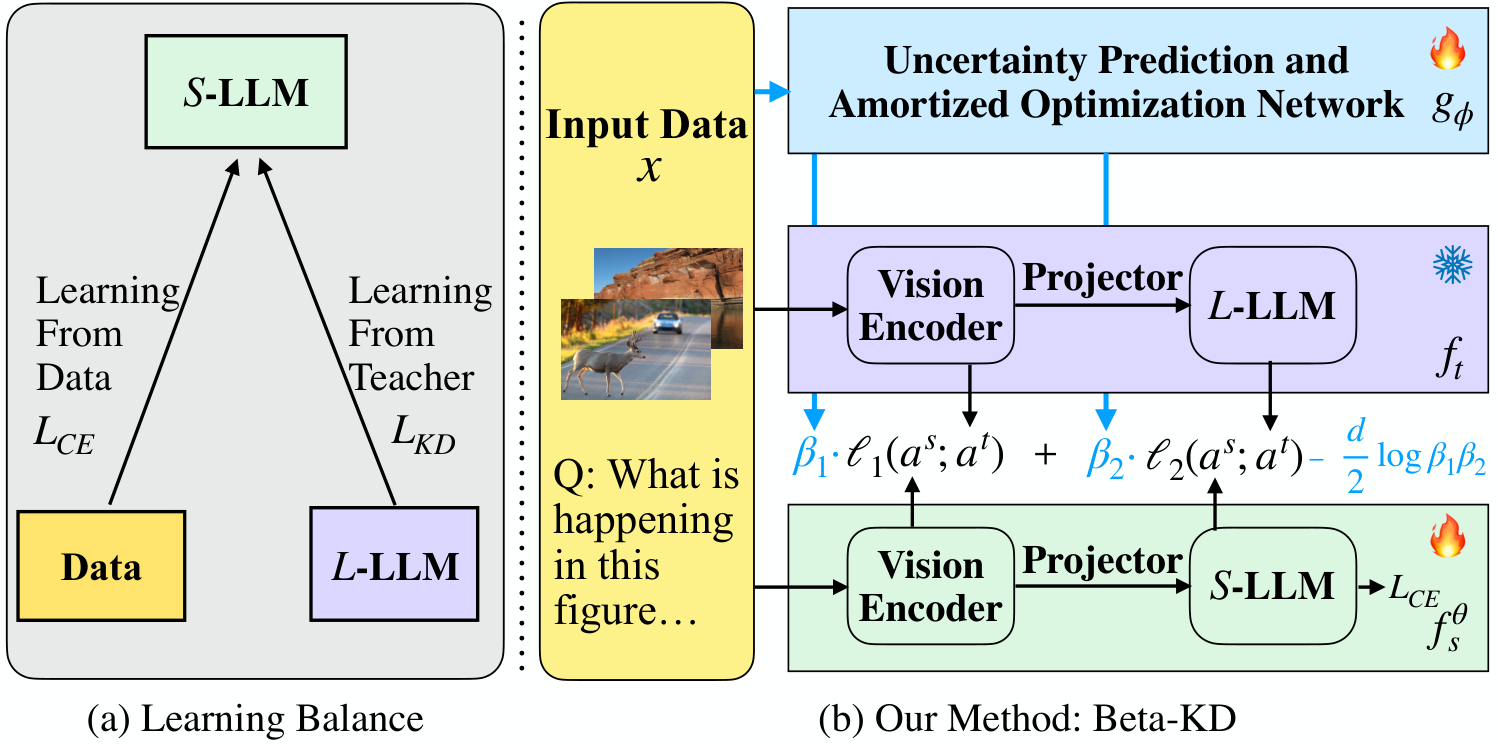
Beta-KD asks whether that weight can be learned rather than searched manually. Its interesting contribution is not a new teacher or a new vision encoder. It is a way to balance data supervision against one or more teacher–student alignment objectives while training a smaller multimodal model. The paper tests task-wide weights and weights predicted separately for each input.
A precision-like weight, not a correctness oracle
The authors treat a mismatch between student and teacher activations as an energy: better agreement has lower energy. In their Bayesian construction, the teacher supplies a prior over student activations. A positive weight called beta controls how concentrated that prior is. Large beta makes the student match the teacher more strongly; small beta relaxes that pressure. The student’s ordinary cross-entropy loss still trains it on the target answers.
Taking the negative log of this prior gives a weighted distillation loss and a normalization term. The paper approximates the latter locally, yielding a training objective that can be read as answer loss + beta × teacher–student discrepancy − a log-beta term. That last term changes how a learned beta is optimized; it is not an additional accuracy measurement. The derivation assumes a suitable local energy minimum and curvature, so this is an approximation under a model of teacher guidance, not proof that a model can measure a teacher’s true error probability.
There are two ways to choose beta. Task-level Beta-KD learns positive weights shared across examples for each supervision channel. Instance-level Beta-KD uses a small network to predict the weights from each input. Student and weighting network are optimized together, replacing a manual search over fixed combinations. Different teacher signals, such as output distributions and intermediate features, can receive separate weights. See the method and equations.
What actually changes in training
For the main MobileVLM V2 experiments, the paper uses a 7B-parameter teacher and a 1.7B-parameter student. It freezes the vision encoder and tokenizer during distillation and fine-tunes the language backbone. This matters for attribution: Beta-KD changes the weighting of supervision while the rest of this training setup is held by the authors’ chosen comparisons; it does not shrink an already trained teacher at inference time. The early loss-design and weighting experiments use ScienceQA, while the broader evaluation uses mixed image–text transfer data and six benchmarks (experiment setup).
The loss itself also matters. Matching teacher and student output probabilities by cosine distance is one tested choice; other rows use KL variants or feature-level alignment. Beta-KD is a weighting framework around those objectives, not one fixed loss that can be credited with every improvement. When an author row replaces the underlying loss and adds Beta-KD, those are two changes; compare it against the matching loss baseline before assigning the gain to weighting.
Read the comparisons in pairs
The cleanest broad comparison in Table 4 holds each loss family fixed. The authors’ reproduced Align-KD row reports a six-benchmark average of 63.4; adding instance-level Beta-KD reports 64.6. The separate Cosine KD row also reports 63.4; adding instance-level Beta-KD reports 65.5. These are reported averages across the paper’s six benchmark metrics, with the MME score divided by 20 before averaging. They are not gains from changing Align-KD directly into the final Cosine-plus-Beta configuration.
| Loss-family setting | Fixed/no Beta-KD | Instance Beta-KD |
|---|---|---|
| Align-KD | 63.4 | 64.6 |
| Cosine KD | 63.4 | 65.5 |
Author-reported rows for the MobileLLaMA 1.4B-backbone setting; the two loss families are separate comparisons. The MME component is normalized to the other metrics' scale. Scroll horizontally on a narrow screen.
The within-family pattern supports the value of adaptive weighting in this setup. It does not mean every distillation objective improves. In the three-loss ScienceQA ablation, Table 3, CE + total-variation distance + feature distillation scores 51.8 overall VQA accuracy with manual weights and 49.0 with instance-level Beta-KD; image-question accuracy likewise falls from 59.7 to 56.8. The MSE-on-probabilities combination also declines against its manual baseline. Those counterexamples qualify the paper’s broad “consistently outperforms” language. They are a useful check against treating a precision-like weight as universally reliable.
A separate Table 5 tests LLaVA-style Qwen students under a Qwen2.5-3B teacher: for the 0.5B student, TextVQA rises from 52.0% with LLaVA-KD to 54.9% with instance-level Beta-KD; ScienceQA rises from 60.6% to 64.4%. This is evidence beyond one student architecture, not an apples-to-apples comparison with MobileVLM’s Table 4 averages. The paper’s training-efficiency table reports 1.82 iterations/s and 47.5 GB GPU memory for Align-KD versus 1.85 iterations/s and 47.6 GB for its instance-weighted variant. That narrow comparison suggests modest weighting-module overhead, not a measured reduction in teacher computation or end-to-end deployment cost.
Where the uncertainty claim stops
The learned beta is a training weight inferred through the chosen objective, not a separately validated probability that a teacher prediction is correct. The paper’s plotted entropy and weight trajectories illustrate its proposed interpretation, but do not establish calibration on known teacher mistakes. The local approximation behind the log-beta term is also conditional on the selected energy and curvature assumptions. Neither result licenses a blanket claim that the method detects all noisy labels or teacher hallucinations.
The six-benchmark averages are author-reported, with no independent replication here. A sensible follow-up would hold the same teacher, student, transfer data, and distillation objective fixed; then compare tuned fixed weights, task-level weights, and instance-level weights across multiple runs. Report accuracy per benchmark, uncertainty variation, and compute for the whole training run. That is a proposed test, not one performed in this post.
Checks to carry into another distillation run
- Compare adaptive weights against a tuned fixed-weight baseline for the same loss, not a different divergence or a larger model.
- Keep label supervision in the accounting: a reduced teacher weight does not remove the cross-entropy training signal.
- Inspect losses that regress, not only the best cosine-distance row; Table 3 shows where instance-level weighting can hurt.
- Measure whether learned weights track actual teacher errors before calling them calibrated uncertainty.
- Separate a small weighting-network overhead from the cost of repeatedly running the teacher during distillation.
Links
- Official CVPR 2026 proceedings entry and paper PDF
- Versioned arXiv HTML and Figure 1 (v1)
- Author-linked Beta-KD repository (no paper-evaluated commit or tagged release verified; its current README’s summary numbers differ from Table 4)
- Figure reuse license: CC BY 4.0