Paper brief
ColBERT: Efficient and Effective Passage Search via Contextualized Late Interaction over BERT
ColBERT precomputes contextual token embeddings for documents, then scores each query through a cheap MaxSim late-interaction step that preserves fine-grained matching without running BERT on every query-document pair.
Why this paper matters
Neural search systems face a recurring trade-off. A cross-encoder such as BERT can jointly read a query and passage, allowing every token to influence every other token before producing a relevance score. This fine-grained interaction is accurate, but expensive: BERT must run again for every query-passage pair. Searching or reranking thousands of passages therefore multiplies the most costly part of the model.
A dual encoder takes the opposite approach. It creates one vector for the query and one for each document, so document vectors can be computed once and indexed. Online scoring becomes fast, but compressing an entire passage into one vector can discard useful evidence about which query token matched which document phrase.
ColBERT introduced late interaction as a middle path. It keeps contextual token-level representations instead of one vector per text, but delays query-document interaction until after the query and document have been encoded independently. The 2020 paper helped establish multi-vector retrieval as a practical design space between single-vector retrieval and full cross-encoding.
The bite
The key idea is to precompute a matrix of contextual embeddings for every document. At query time, ColBERT encodes the query once into another matrix. Each query vector searches across all vectors in a candidate document and keeps only its strongest match. The model then sums those per-query-token maxima into one relevance score.
In compact notation, the score is Σᵢ maxⱼ(Eqᵢ · Edⱼ): for every query embedding i, find the document embedding j with maximum similarity, then add the resulting values. The paper calls this operation MaxSim.
This preserves more local matching structure than comparing two pooled vectors. At the same time, the expensive document-side BERT computation moves offline. MaxSim itself is cheap, has no trainable parameters, and is compatible with vector indexes that can prune most of a large collection before exact reranking.
How it works
ColBERT uses a shared BERT backbone for queries and documents, while special [Q] and [D] markers tell the model which input type it is processing. A linear projection reduces every contextual token representation to a smaller embedding—128 dimensions in the main experiments—and L2 normalization makes dot products equivalent to cosine similarity.
The query encoder pads short queries with [MASK] tokens to a fixed length. The authors describe this as query augmentation: the additional contextual positions can learn expansion-like or reweighting behavior. The document encoder does not add masks and filters punctuation embeddings to reduce storage.
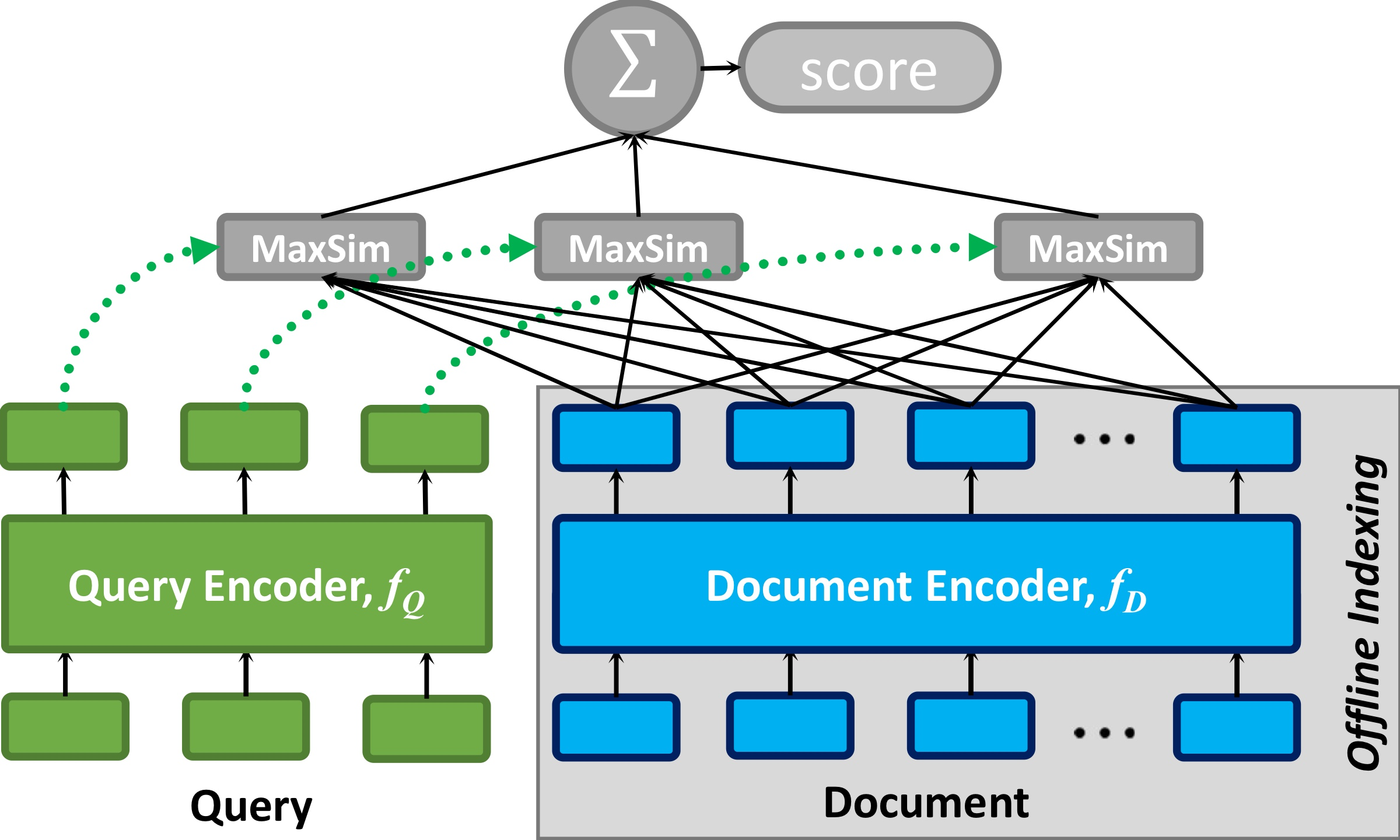
Training uses triples containing a query, a positive passage, and a negative passage. The BERT backbone, projection layer, and special marker embeddings are optimized end to end with pairwise softmax cross-entropy. Document embeddings are then produced offline and stored for serving.
The same score supports two modes. In reranking, ColBERT exhaustively applies MaxSim to a smaller candidate set, such as BM25’s top 1,000 passages. In full retrieval, each query token vector searches a FAISS IVFPQ index over document token vectors. The system maps the retrieved vectors back to their source documents, unions those candidates, and performs exact ColBERT reranking on the reduced set.
What to look at in the results
On MS MARCO reranking, ColBERT reports 34.9 MRR@10 on both the development and official evaluation sets. The original BERT-base result is 34.7 on development, while BERT-large reaches 36.5 on development and 35.9 on evaluation. ColBERT therefore retains most of the cross-encoder effectiveness in this protocol rather than matching every larger baseline.
The efficiency difference is the headline. Under the paper’s single-V100 measurements, ColBERT reranks the top 1,000 passages in 61 ms using about 7 billion FLOPs per query. The authors’ BERT-base measurement takes 10,700 ms and about 97 trillion FLOPs. ColBERT’s timing includes gathering and transferring document representations, tokenizing and encoding the query, and MaxSim; the baseline timings cover GPU scoring and exclude CPU text preprocessing. The paper summarizes this as more than a 170× latency reduction and 13,900× fewer FLOPs.
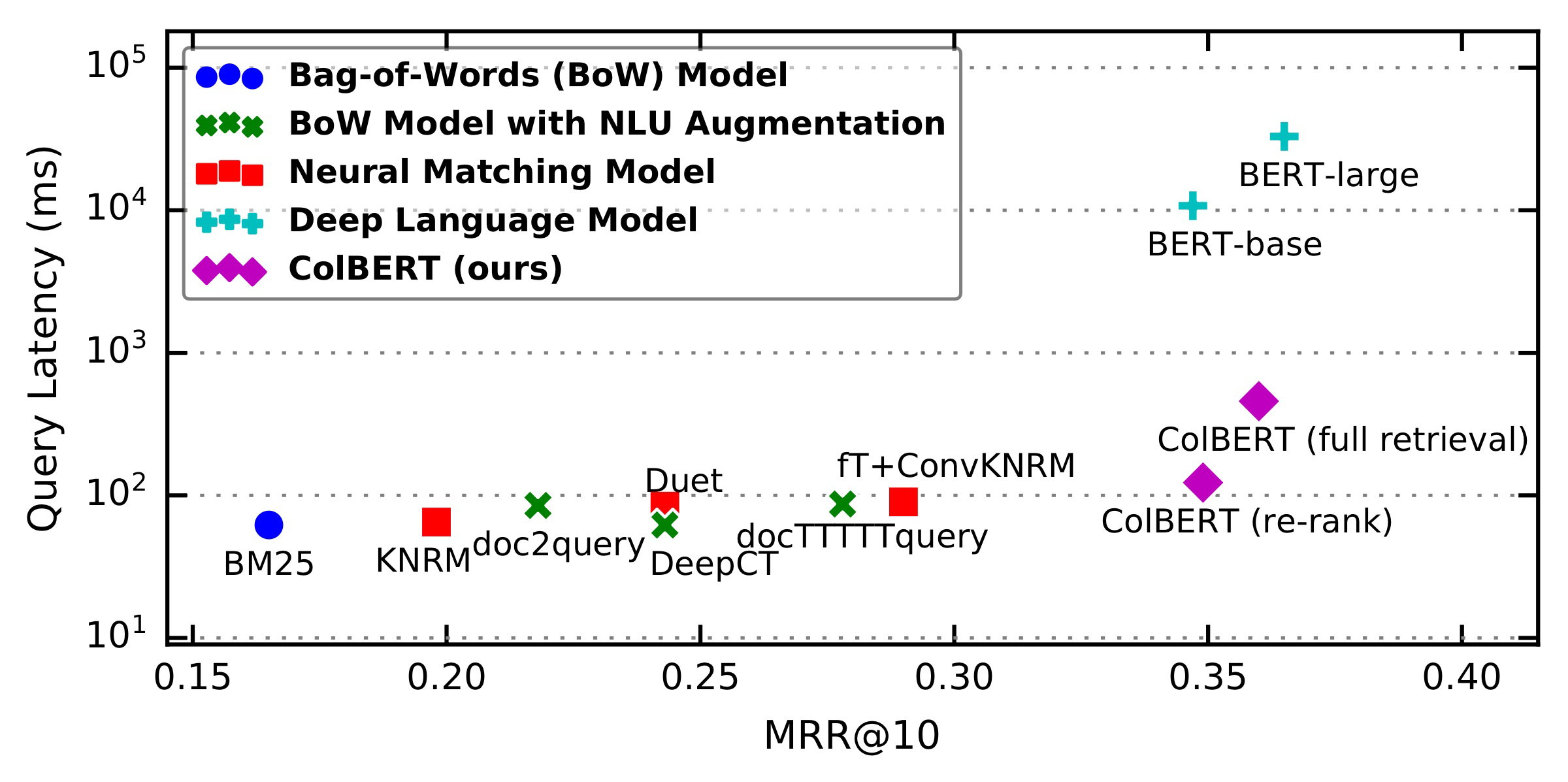
Full-collection retrieval over 8.8 million MS MARCO passages reaches 36.0 development MRR@10, 96.8 Recall@1000, and 458 ms latency. This exceeds reranking with the same model because it can recover relevant passages outside BM25’s candidate set. The cost is a slower first-stage search than highly optimized lexical systems and a much larger multi-vector index.
That storage cost matters, and the paper reports different stores for different modes. Its 128-dimensional, four-byte cosine reranking representation store occupies 286 GiB, while the 128-dimensional, two-byte end-to-end L2 configuration occupies 154 GiB. A compact cosine reranking configuration with 24-dimensional, two-byte vectors uses 27 GiB, while MRR@10 declines from 34.9 to 33.9. The paper also reports about three hours to encode MS MARCO using four Titan V GPUs. Late interaction moves work offline; it does not make indexing free.
The evidence has historical and methodological limits. MS MARCO uses sparse relevance judgments, and TREC CAR is synthetic and Wikipedia-derived. Latency depends on 2020 hardware, software, batching, and candidate-generation choices. Table 1 reports reranking latency without BM25 retrieval, whereas the plotted reranking points add it. The experiments do not test multilingual retrieval, domain shift, robustness, or modern optimized retrievers. Finally, the current ColBERT repository primarily documents later versions; reproducing this paper requires the explicitly preserved colbertv1 branch.
Practical takeaways
- Precompute the expensive side when documents change less frequently than queries arrive.
- Keep multiple token-level vectors when one pooled embedding loses important matching detail.
- Design the scoring function together with the index: MaxSim is useful partly because it supports candidate pruning.
- Report retrieval quality with latency, FLOPs, memory footprint, indexing time, and candidate-generation protocol.
- Treat vector granularity as a systems knob. Richer document representations improve matching but increase storage and transfer cost.