Paper brief
GenRec: An LLM-Backed Recommendation Ranker at Netflix
GenRec verbalizes Netflix interaction histories for an adapted language model, then uses a catalog-aware scoring head and prefill-only inference to rank in-catalog items under production cost constraints.
Why this paper matters
Industrial recommenders accumulate complexity. A mature system may combine thousands of engineered features, specialized interaction networks, sequence models, multi-task objectives, and infrastructure built for particular content types or product surfaces. That machinery can be effective, but extending it is expensive: a new surface or media type may require another round of feature design, architecture work, serving changes, and experiments.
GenRec explores a different division of labor at Netflix. Instead of expressing member history primarily through a fixed feature schema, it converts interactions, item metadata, and request context into text for a language-model backbone. The engineering problem shifts from defining every feature interaction to deciding which events belong in the context, how much detail each event deserves, and how to fit useful history inside a limited token and compute budget.
The paper is especially useful because it does not stop at an offline prototype. It describes a catalog-constrained scoring architecture, reward integration, prefill-only serving on vLLM, and a production A/B test. At the same time, it is an internal-system report: the data, exact foundation model, absolute metrics, reward models, and implementation are not public. The right reading is therefore a production design study with strong internal evidence, not a reproducible public benchmark.
The bite
GenRec is an LLM-backed ranker, but it does not serve recommendations by generating title names token by token. The model consumes a verbalized representation of a member’s history and current context. A decoder-only Transformer turns that prompt into a pooled user-context representation. A catalog-aware ranking head then compares that representation with learned item embeddings and scores the available catalog—or a supplied candidate set—in one forward pass.
This distinction solves two practical problems. First, output is restricted to known catalog items, avoiding free-form hallucination of unavailable titles. Second, ranking does not require autoregressive decoding or beam search. Netflix runs the model in a prefill-only configuration: process the context once, produce catalog scores, and stop.
The model is trained in two phases. Phase 1 adapts an open-source LLM to proprietary Netflix data, building broader user and content understanding. Phase 2 is the faster-cadence recommendation stage. It post-trains the foundation model on ranking conversations, application-specific labels, and reward signals so the system can track new releases, changing popularity, and recent member interests without rebuilding the foundation model each time.
How it works
The input pipeline verbalizes several signal families: request context such as device, locale, time, and surface; profile and interaction history; item identifiers and metadata; and the ranking task. Historical engagement becomes a single-turn or multi-turn conversation whose assistant side represents observed feedback, such as a play, duration, abandonment, or explicit rating.
Context construction is selective rather than exhaustive. High-signal events can retain richer metadata. Very short or noisy interactions may be omitted. Repeated behavior such as a binge session can be compressed, while cold-start or newly released items may receive more description. Recent and medium-term history gets more detail; older behavior can be summarized. In this system, prompt design functions much like feature selection, except that token length directly affects LLM serving cost.
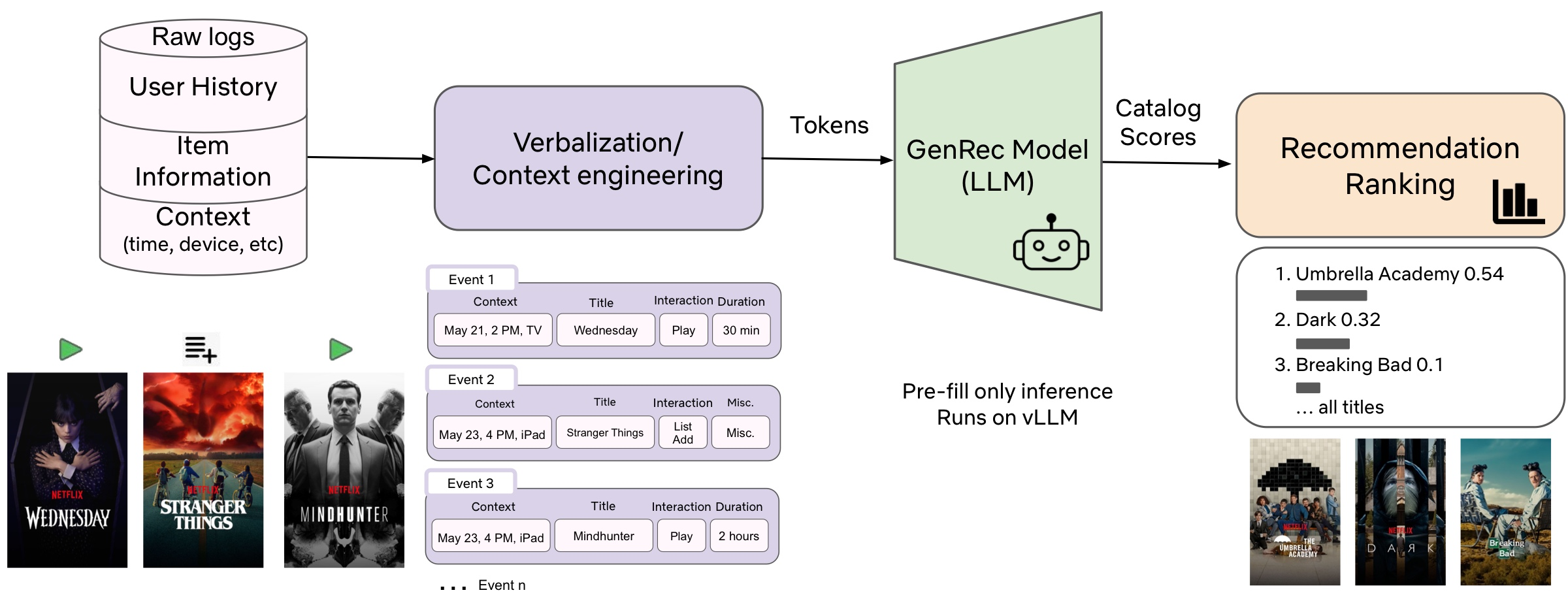
Phase 2 combines a catalog-ranking loss with a language-modeling loss and, where applicable, other objectives. The language objective preserves the backbone’s ability to understand textual context and supports future prompt steering; only the ranking path is used for current serving. The LLM, ranking head, and item embeddings are trained jointly.
The paper also weights ranking examples with outputs from separate reward models. These rewards approximate longer-term satisfaction and rebalance behavior across content types, engagement types, and launch stages. This is simpler than full reinforcement learning, but it embeds product objectives into training. Because the reward construction is proprietary, readers cannot independently inspect which behaviors receive greater weight or how trade-offs are governed.
What to look at in the results
The central comparison is against Netflix’s mature production ranker. Offline, the authors report that GenRec uses about 40 times fewer Phase-2 labeled examples yet achieves a 1.6% relative lift in mean reciprocal rank (MRR). Absolute MRR, data counts, catalog size, and evaluation details are not disclosed, so this measures internal improvement rather than performance on a public leaderboard.
The online evidence comes from an experiment on key batch-compute surfaces covering approximately 10% of Netflix traffic for four weeks. The paper reports a 0.115% relative improvement in a short-term homepage engagement metric with p = 3.1 × 10⁻¹⁰, and a 0.006% relative improvement in a long-term core metric with p = 0.025.
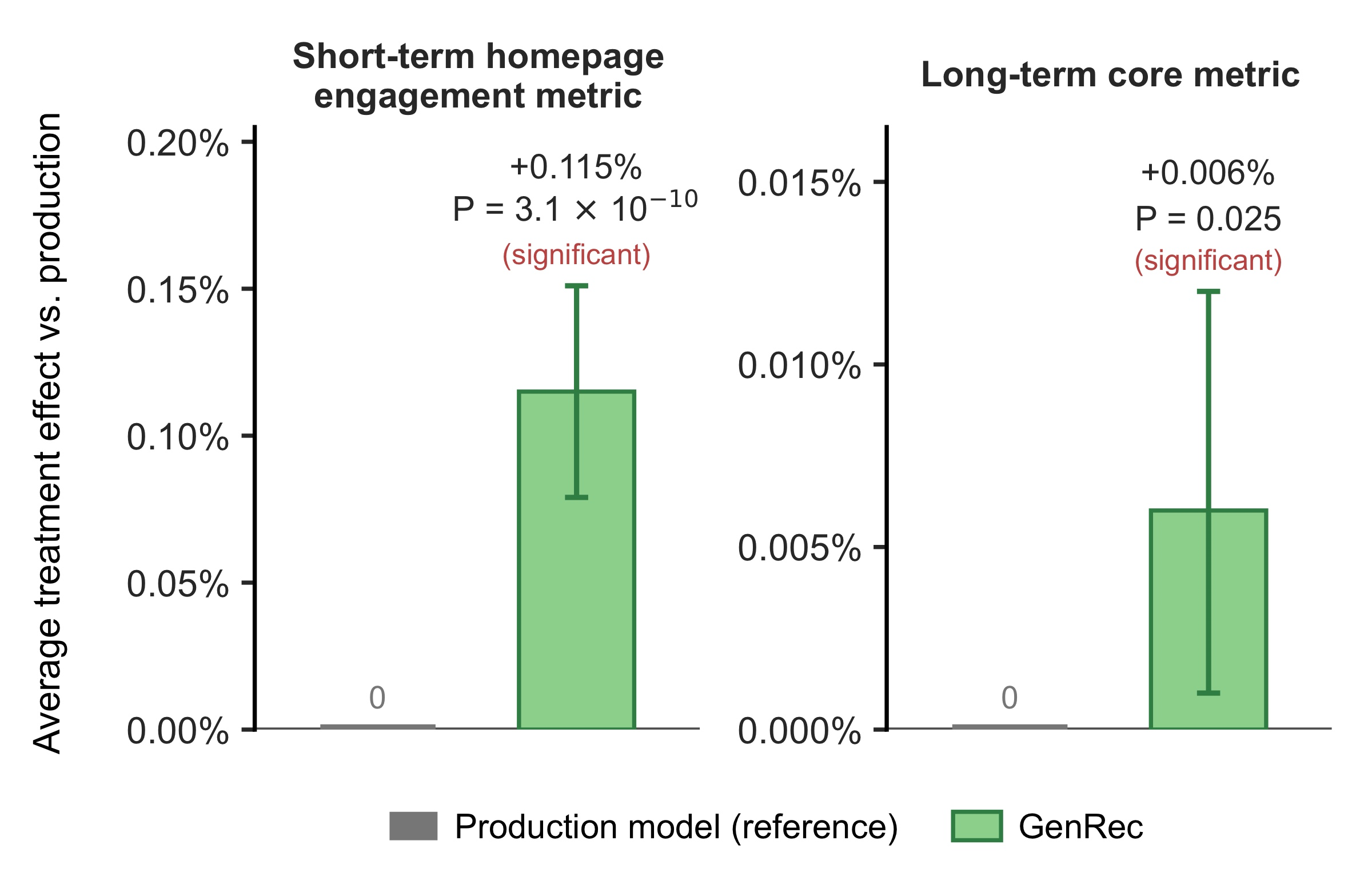
These numbers require two readings at once. The effects are numerically small. They are also statistically detectable in a large experiment, and the authors argue that the long-term lift is meaningful at Netflix scale. Statistical significance alone does not establish practical value, however; that judgment depends on metric definitions, confidence intervals, costs, and downstream effects that are not public.
The ablations help explain the system. Starting from an off-the-shelf LLM, Phase 1 reportedly improves offline ranking metrics by 10–20%. Phase 2 adds roughly 35–50% over a freshly trained Phase-1 model, with its relative benefit increasing as the slower-updated foundation becomes stale. Across approximate 1B- and 10B-parameter backbones, offline MRR rises monotonically as Phase-2 data scales from 1x to 20x, while larger models perform better under the paper’s fixed training-budget comparison.
The most reusable systems result concerns context length. The authors reduce prompts from about 5,000 to 1,700 tokens with negligible offline degradation, and report that serving cost falls to roughly one-third because this workload is largely compute-bound. But no hardware, latency, throughput, or dollar-cost figures are given. There is also no public code, dataset, model checkpoint, or reproduction recipe, and the evaluated traffic covers selected surfaces rather than all Netflix recommendations.
Practical takeaways
- Treat context engineering as a measured selection problem: remove low-signal events, compress repetition, and find the elbow where more history stops paying for its token cost.
- An LLM recommender need not generate item names. A catalog-aware head can preserve valid outputs and avoid autoregressive serving overhead.
- Separate low-cadence domain adaptation from high-cadence ranking post-training when knowledge and freshness evolve on different schedules.
- Evaluate quality and operating cost together. Larger models, longer prompts, and more data improve internal metrics here, but the best production configuration lies on a quality-cost frontier.
- Read tiny online lifts with the exposure period, metric definition, uncertainty, compute cost, and practical significance—not only the p-value.