Paper brief
MMR-AD: A Large-Scale Multimodal Dataset for Benchmarking General Anomaly Detection with Multimodal Large Language Models
MMR-AD builds a large multimodal industrial anomaly benchmark with reasoning traces, localization annotations, and cross-dataset evaluation splits, then uses it to show that current generalist MLLMs still struggle badly on practical anomaly detection and especially anomaly localization.
Why this paper matters
Industrial anomaly detection keeps moving toward a harder goal: not just detecting defects in one known product category, but handling new categories and new anomaly types without retraining. That is the practical version of general anomaly detection, and it is exactly where multimodal large language models look tempting because they can compare images, use language priors, and explain their decisions.
This paper matters because it argues that the field is missing the right benchmark and the right training data. Existing anomaly datasets are mostly image-only, while current multimodal anomaly datasets are either too small, too coarse, or too far from real industrial settings. MMR-AD is the paper’s attempt to fill that gap with a large-scale multimodal dataset designed for both training and evaluation.
The bite
The key idea is to reconstruct industrial anomaly detection as a multimodal reasoning task rather than a plain classification task. MMR-AD pairs anomaly images with generated reasoning-style text, precise anomaly boxes, anomaly labels, and normal reference images so models can learn to compare, explain, detect, and localize defects in one setup.
That framing is important because the paper is not only introducing a dataset. It is also making a broader claim: current strong generalist MLLMs still fall well short of industrial requirements, especially when they need to localize anomalies precisely. The dataset is meant to expose that gap clearly and provide a path for post-training models that can reason through anomaly decisions instead of only guessing a final label.
How it works
MMR-AD is built from 14 public anomaly detection datasets, but the authors do not simply merge them. They manually review roughly 190K original images, remove low-quality samples, and add bounding-box annotations and text labels for anomalous regions. The final dataset contains 127,137 samples from 188 product categories, with 395 anomaly types and 112,875 annotated anomalous regions.
The multimodal part comes from an automatic text-generation pipeline. For each sample, the system provides a normal reference image, the target image, anomaly hints, and visual cues to a strong MLLM, then asks it to generate a think-then-answer response. The generated text is kept only if the extracted anomaly answer matches the ground-truth regions. A useful way to read the dataset design is as supervised anomaly reasoning data: the model is encouraged to compare what normal looks like, describe why something is wrong, and only then give a structured answer.
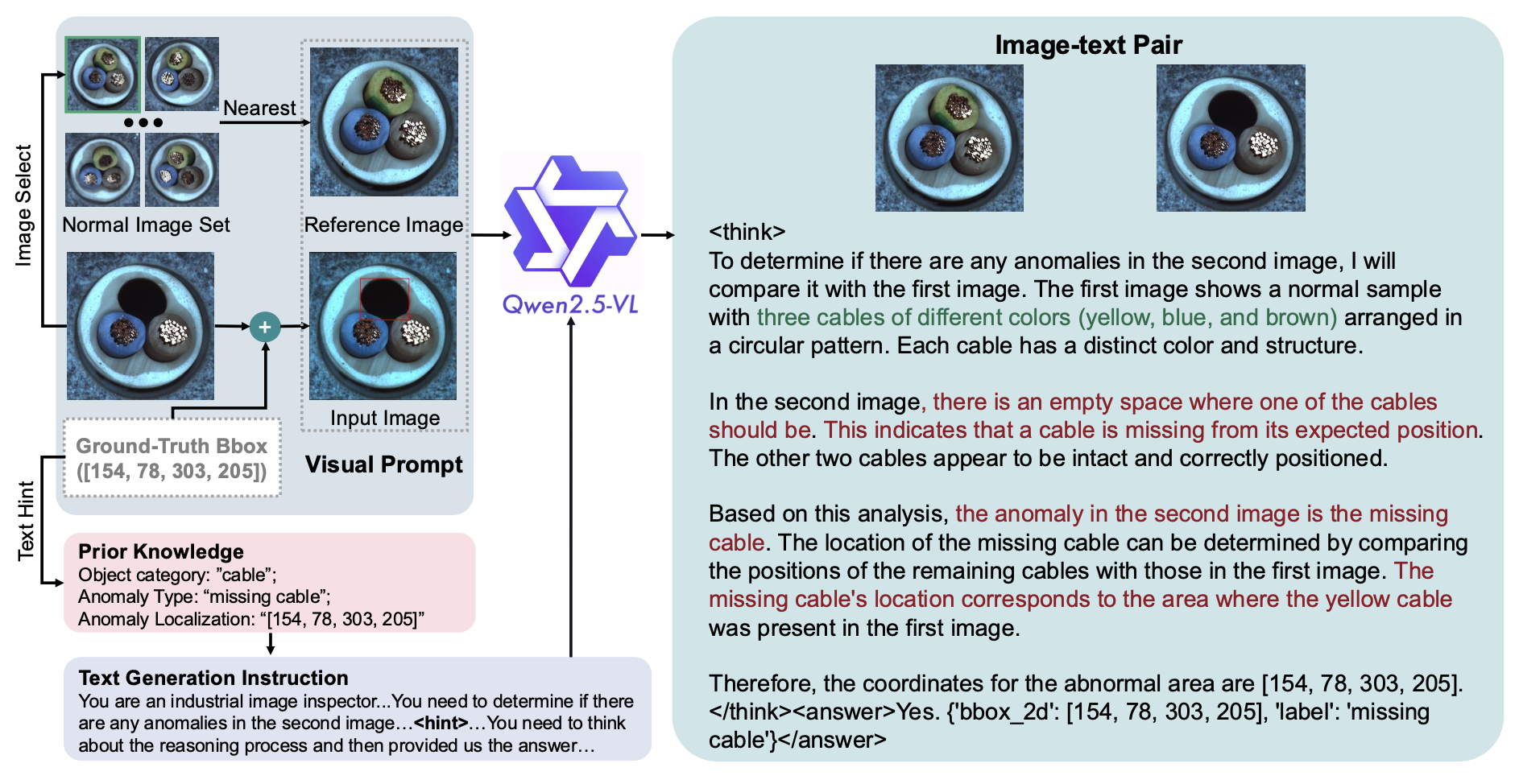
The paper also introduces a baseline called Anomaly-R1. It starts from Qwen2.5-VL-7B, first applies supervised fine-tuning on MMR-AD for cold-start initialization, and then uses rule-based reinforcement learning. The reward design matters here. The model is rewarded not only for saying whether an image is anomalous, but also penalized when its predicted anomaly boxes fail to align with the true ones. The authors further add contrastive sampling and optional anomaly-type domain knowledge to stabilize learning and improve reasoning quality.
What to look at in the results
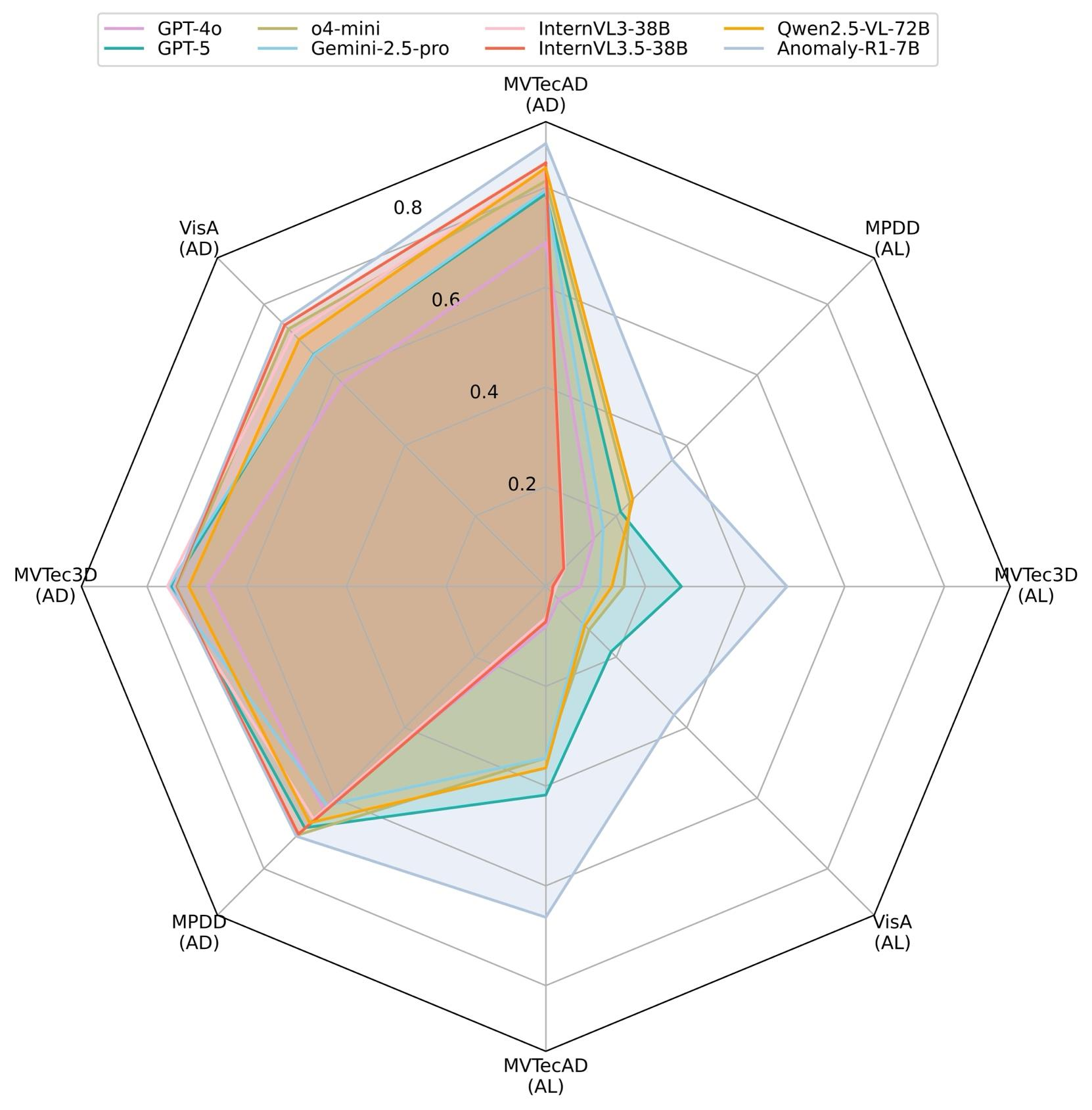
The first result to notice is the gap between general-purpose MLLMs and practical anomaly detection needs. On the paper’s evaluation subsets such as MVTecAD, VisA, MVTec3D, and MPDD, even strong closed models like GPT-5 and Gemini-2.5-pro remain much weaker on precise anomaly localization than industrial users would want. That matters more than any single leaderboard rank, because it supports the paper’s central argument that web-pretrained multimodal models still lack the right domain-specific grounding.
The second result is the jump from the base Qwen2.5-VL-7B model to Anomaly-R1 after post-training on MMR-AD. The localization gains are especially large, which is the clearest evidence that the dataset is doing useful work rather than just adding more generic supervision. A useful way to read the experiments is to focus less on whether Anomaly-R1 beats every specialized anomaly detector and more on whether multimodal post-training meaningfully narrows the gap for generalist models. In this paper, it does.
The ablations are also worth reading carefully. Removing reasoning text, removing the normal reference image, or removing the cold-start stage all hurts performance. That makes the paper’s position fairly concrete: anomaly reasoning seems to benefit from explicit comparison, explicit intermediate explanation, and a staged training recipe rather than pure zero-shot prompting or pure reinforcement learning.
One limitation is that the dataset’s reasoning texts are still machine-generated, even if they are filtered for consistency. Another is that the benchmark remains tied to public anomaly datasets and to the paper’s text-generation pipeline. So the long-term value is probably not that MMR-AD is the final dataset, but that it establishes a stronger template for how multimodal anomaly benchmarks should be built.
Practical takeaways
- General anomaly detection is not only about class transfer; it also depends on whether the model can explain and localize defects, not just answer yes or no.
- Normal reference images appear genuinely useful for anomaly reasoning because they turn the task into structured comparison rather than blind recognition.
- Reasoning-style supervision helps more than short answer-only supervision in this setting, especially when localization quality matters.
- If you want to evaluate multimodal anomaly systems seriously, localization metrics are a much better stress test than image-level accuracy alone.
- When reading the paper, focus on the benchmark design and the Anomaly-R1 ablations together, because that is where the case for multimodal post-training becomes convincing.