Baidu’s October 27 release puts an oddly literal question behind its name: how does one OCR request cover a hundred-page document without retaining every page’s visual key–value (KV) cache on the GPU at once? Its answer is not an infinite context window. It is a model that selects a small visual working set, paired with a serving system that processes overlapping groups of pages and discards old page caches.
The attention budget and the page window
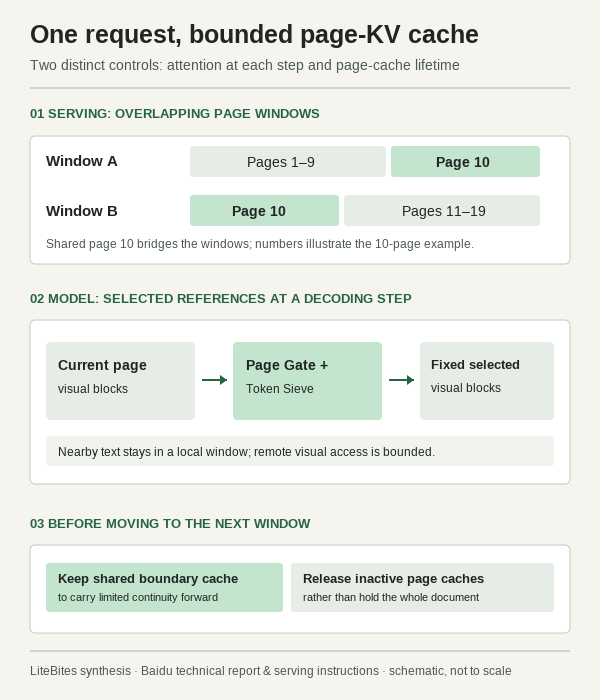
The new technical report calls the model’s attention scheme Sparse Reference Sliding Window Attention, or SR-SWA. A local window keeps nearby text in view. A Page Gate narrows candidate image blocks to the page being parsed; a Token Sieve selects a fixed number of relevant blocks. The previous Unlimited OCR bounded its text history but could still attend to an expanding set of earlier visual tokens. Version 2 bounds the selected visual references as well. That is a claim about per-step attention, not a promise that the entire document is remembered exactly.
A second change handles the memory that image pages occupy before decoding. The serving pipeline divides a long document into overlapping page windows, reuses the shared boundary page’s key–value cache, and releases inactive page caches. Baidu’s example SGLang configuration uses ten-page windows and a customized wheel. To a client, it can be one request; internally, it is sequential work with limited retained context. That distinction matters for a table continuing across a window boundary—and for headings that depend on much earlier pages.
A long-document result with a long protocol
The report provides a useful contrast, but its scores are Baidu-reported system results, not independently reproduced model-only measurements. The three tests below have different document lengths and scoring rules; their numbers should be read within each row, never as one combined ranking.
| Test | Unlimited-OCR-2 | Selected reported comparisons |
|---|---|---|
| MPDocBench, up to 30 pages | 84.59 | Unlimited OCR: 61.89 |
| MarathonDocBench, 103–300 pages | 77.06 | Kimi-K3: 33.74 |
| OmniDocBench v1.6, single pages | 94.02 | Unlimited OCR: 93.92; TeleOCR: 96.91 |
Source: Baidu's technical report, Tables 1–3. MarathonDocBench is Baidu's own released benchmark. The table is a selection, not an independent leaderboard; swipe or scroll to see all columns.
MarathonDocBench releases images and annotations for 100 documents, but its evaluation needs a patched MPDocBench toolkit and explicit matching and table-scoring timeouts. The dataset’s instructions say some general-model requests exceed provider image or output limits: images may be downscaled, documents skipped, and failed predictions scored as empty. Baidu also post-processes its block output into evaluation Markdown. So the large Marathon lead is evidence about this whole benchmark setup, not an isolated gain from SR-SWA or a fair promise for every deployment. The report’s 7.0× and 5.6× comparisons concern per-step decoding latency against full attention and the older attention scheme at hundred-page scale—not end-to-end PDF processing speed.
What to test before handing it a book
Baidu’s own limitations section says the sparse scheme does not preserve global document information well, particularly heading hierarchy. A smaller page window also reduces memory at the possible expense of cross-page merging. The public MIT-tagged checkpoint and benchmark data make testing possible, but the recommended long-document path uses custom serving code; the hosted report for version 2 is not the June arXiv paper linked in the card’s citation, which describes version 1.
For a real archive, try short pages, very long pages, and tables crossing both page and window boundaries. Check whether every page completes, whether headings and table continuations survive, and how often provider caps, retries, output limits, or post-processing change the result. “Unlimited” is a useful engineering direction; the present evidence demonstrates an author-reported hundred-page regime, not unlimited accuracy or cost-free memory.