“MinerU” names a project and several different parsers, not one interchangeable model. Its October 11, 2026 release adds self-hosted parsing API endpoints; that current code is not necessarily the snapshot evaluated in older papers.
Four papers, not one benchmark row
| Paper ↗ | Research focus | Publication | Hugging Face ↗ |
|---|---|---|---|
| MinerU (2024) ↗ | PDF extraction pipeline and postprocessing | arXiv technical report | PDF-Extract-Kit components ↗ |
| MinerU2.5 ↗ | Coarse-to-fine, 1.2B vision-language parser | ACL 2026 Industry Track; arXiv version | 2509 checkpoint ↗ |
| MinerU2.5-Pro ↗ | Data engine and training with 2.5 architecture retained | arXiv technical report | 2604 checkpoint ↗ |
| MinerU-Diffusion ↗ | 2.5B block-wise diffusion decoding | ECCV 2026; arXiv version | V1 0320 checkpoint ↗ |
PDF-Extract-Kit contains component weights, not one MinerU model. Swipe horizontally on small screens.
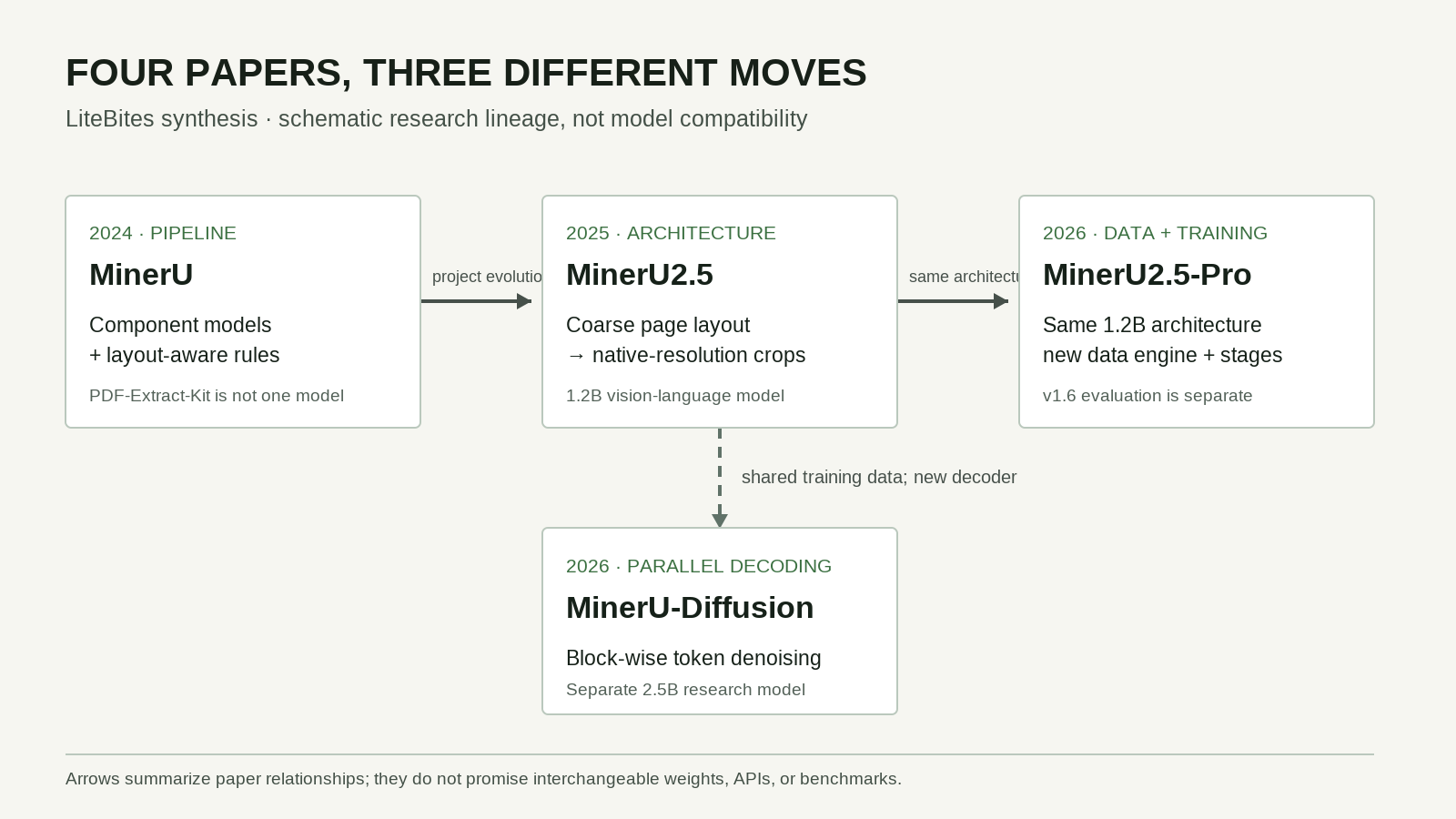
The original report combined PDF-Extract-Kit models with preprocessing and postprocessing rules to extract text, formulas, tables, and layout. MinerU2.5 changed the center of gravity: first analyze a reduced-resolution page for layout, then read targeted crops at native resolution. Its paper is in ACL’s 2026 Industry Track proceedings even though the project README still offers an arXiv-preprint BibTeX entry.
Results belong to their protocols
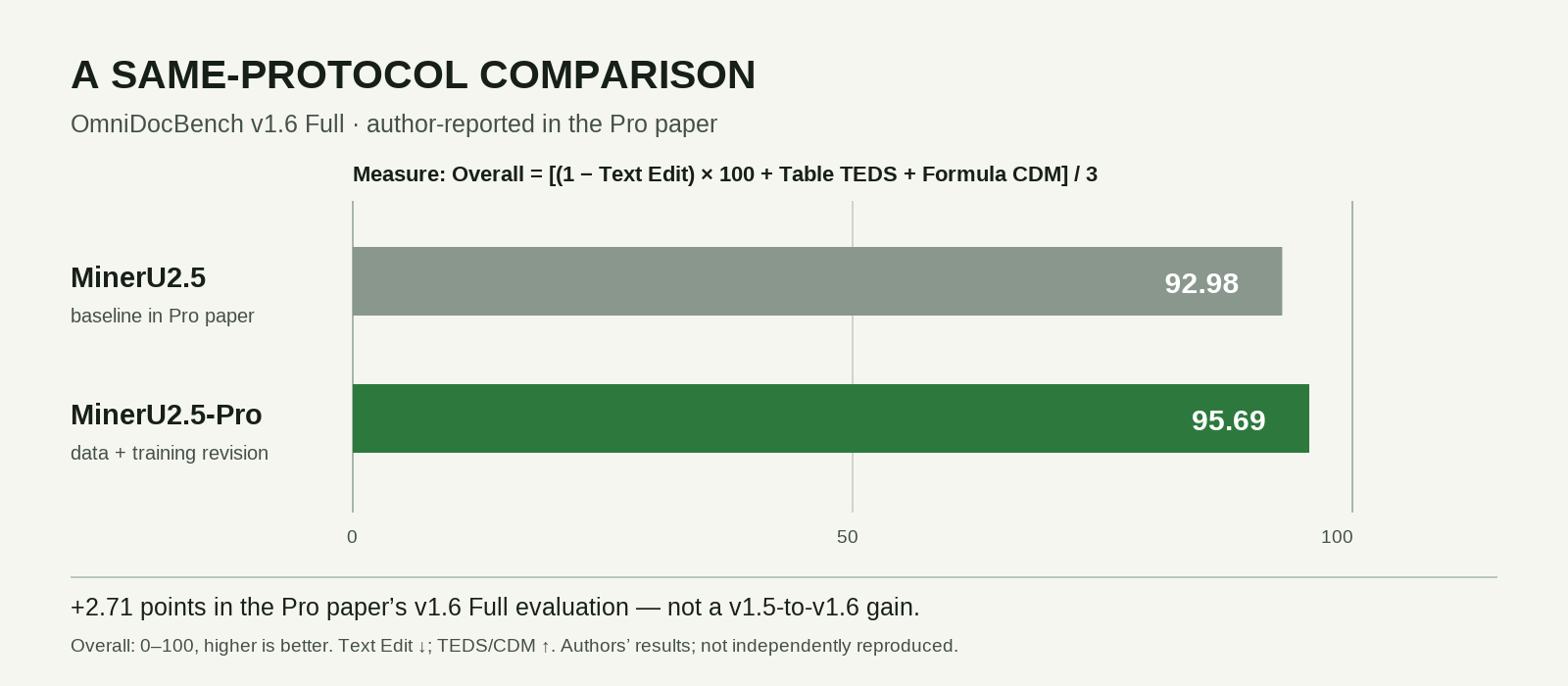
The papers report useful numbers, but not on one common test. The original work measures components; the later papers evaluate end-to-end models under different OmniDocBench versions and layout settings. Selected author-reported rows are not a combined leaderboard. Only the paired v1.6 Full rows share one paper and protocol. Their Overall measure is a composite, not NID, TEDS, or F1 alone: [(1 − Text Edit) × 100 + Table TEDS + Formula CDM] / 3 (formula).
| System / model | Exact evaluation scope | Reported result |
|---|---|---|
| MinerU-era layout component ↗ | Academic-paper validation; detector mAP (2024 report, Table 3) | 77.6 mAP |
| MinerU2.5 ↗ | OmniDocBench v1.5; no supplied layout (2.5 paper, Table 5) | 90.67 overall |
| MinerU2.5 baseline ↗ | OmniDocBench v1.6 Full (Pro paper, Table 3) | 92.98 overall |
| MinerU2.5-Pro ↗ | OmniDocBench v1.6 Full (Pro paper, Table 3) | 95.69 overall |
| MinerU-Diffusion ↗ | OmniDocBench v1.5; no ground-truth layout (Diffusion paper, Table 1) | 88.94 overall |
The first row measures a layout detector, not complete MinerU. “No supplied layout” requires the model to predict it. Do not compare v1.5 with v1.6 as one leaderboard.
Pro changes the data; Diffusion changes the decoder
MinerU2.5-Pro keeps the 1.2B architecture and focuses on sample selection, annotation checks, and staged training. The authors also revised OmniDocBench to v1.6, adding a hard subset and changing matching rules. The chart above uses their same-protocol comparison, not the older v1.5 row. The linked 2604 checkpoint is the paper-era artifact; a newer 2605 model under the same account should not silently replace it in a paper comparison.
MinerU-Diffusion goes another way: instead of generating the document representation left-to-right, it uses block-wise diffusion to decode multiple tokens in parallel. It has a separate code repository and an ECCV 2026 proceedings record. Its reported decoding speedup is not a measured end-to-end speedup for the main MinerU application, and its checkpoint is not a drop-in renaming of 2.5-Pro.
Where the code and demos fit
Use the maintained MinerU repo for installation; its README links an official Hugging Face demo. Diffusion has separate code and a model card. Current main, demos, and model cards can change independently of paper versions. Check each model card’s license and runtime requirements before local inference.
If you are choosing a starting point
- Use the original report to understand why layout, OCR components, and postprocessing were combined; its component bundle is not a one-command end-to-end model.
- Start from the 2.5 paper and 2509 checkpoint for the coarse-to-fine VLM; use the ACL record for a formal citation.
- Read Pro’s v1.6 evaluation rules before comparing scores; keep its 2604 checkpoint distinct from later weights.
- Treat Diffusion as a separate decoding research line. Test full-page quality and latency in your own workflow rather than transplanting a decoder-only speed claim.
Sources
- MinerU 4.0.12 release — OpenDataLab, October 11, 2026
- Maintained MinerU repository and official demo link
- Original MinerU technical report
- MinerU2.5 — ACL 2026 Industry Track
- MinerU2.5 arXiv version
- MinerU2.5-Pro technical report
- MinerU-Diffusion — ECCV 2026
- MinerU-Diffusion arXiv version
- MinerU-Diffusion implementation
- Official OpenDataLab Hugging Face models and demo